
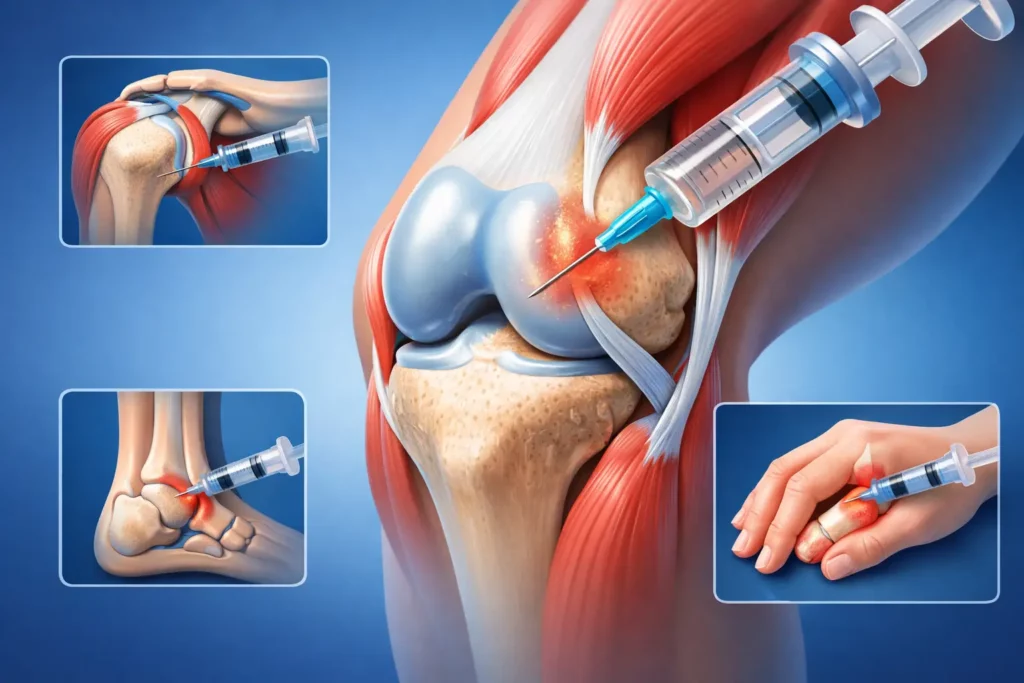
Pain around a joint is not always coming from the joint itself. In many cases, the real source is the soft tissue around it – a tendon, bursa, ligament or inflamed tendon sheath. That is where soft tissue joint injections can make a meaningful difference. Used at the right time, and in the right place, they can calm inflammation, reduce pain and help you move forward with treatment rather than simply managing symptoms.
For people dealing with persistent shoulder pain, outer hip pain, plantar fasciitis, tennis elbow or an inflamed bursa, the challenge is often not just discomfort. It is the way pain starts to limit sleep, exercise, work and confidence in movement. A targeted injection is not a shortcut or a cure-all, but it can be a highly effective part of a broader recovery plan when assessment has been thorough and the diagnosis is clear.
What are soft tissue joint injections?
Soft tissue joint injections are injections placed into structures around a joint rather than directly inside the joint space. These structures may include tendons, bursae, tendon sheaths and other irritated soft tissues that are driving pain. The goal is usually to settle inflammation, create a window for rehabilitation and improve function.
This matters because pain around a shoulder, knee, ankle or hip may feel like a joint problem, but the underlying issue can be outside the joint. A painful bursa at the side of the hip, for example, can make walking and lying on that side difficult. An inflamed tendon sheath around the wrist or ankle can cause sharp pain with daily tasks. Treating the correct structure is what makes intervention more precise.
In practice, the medication used depends on the condition being treated. A corticosteroid is commonly used to reduce inflammation, often combined with local anaesthetic. In some cases, other injection approaches may be considered depending on the diagnosis, your medical history and the wider treatment plan.
When are soft tissue joint injections used?
These injections are usually considered when pain has lasted long enough to affect normal activity, when rehabilitation is being held back by pain, or when simpler measures have not worked well enough. Rest alone is rarely a full answer for tendon and soft tissue problems, but equally, pushing through significant pain often prolongs the issue.
Common reasons for treatment include bursitis, tendinopathy, tendon sheath irritation and localised inflammatory pain around a joint. Shoulder impingement-related bursal pain, trochanteric pain around the hip, plantar fascia pain, tennis elbow and trigger points in selected cases may all be assessed for injection treatment. The key point is that suitability depends on diagnosis, not just symptoms.
There is also an important trade-off here. An injection may reduce pain quickly, but if the mechanical cause is not addressed, symptoms can return. That is why injections work best as part of integrated musculoskeletal care, not as a standalone fix.
Why diagnosis comes first
A good outcome starts well before the injection itself. The first step is a detailed clinical assessment to work out what is actually generating pain, what movements aggravate it, how long it has been present and what treatments have already been tried.
Imaging can play a major role when symptoms are persistent or the diagnosis is uncertain. Ultrasound is particularly useful for many soft tissue conditions because it can assess tendons, bursae and other superficial structures in real time. It can also help distinguish between conditions that feel similar but need very different treatment.
This is one of the biggest advantages of an integrated clinic model. When assessment, imaging, injection therapy and rehabilitation sit under one roof, treatment planning becomes more efficient and more accurate. Instead of guessing whether pain is coming from the joint, the tendon or the bursa, you can often get fast, accurate insight and a clearer route back to movement.
Ultrasound-guided soft tissue joint injections
For many patients, image guidance improves both confidence and precision. Ultrasound-guided soft tissue joint injections allow the clinician to visualise the target structure during the procedure and place the medication exactly where it is intended.
This is especially useful when the area is small, inflamed or close to other sensitive structures. It also helps confirm that the treatment is being delivered to the tissue most likely to be causing symptoms. In a complex shoulder, for example, the difference between a subacromial bursa injection and a glenohumeral joint injection is clinically important.
Not every injection must be ultrasound-guided, but for many soft tissue problems it offers a more accurate and evidence-based approach. For patients who have already had unsuccessful treatment elsewhere, that precision can matter.
What happens during the procedure?
Most soft tissue injections are straightforward and relatively quick. After assessment and consent, the skin is cleaned carefully and the area is identified. If ultrasound is being used, the target tissue is visualised first. The medication is then injected into the planned site using a fine needle.
You may feel pressure or a brief sharp sensation, but the procedure is generally well tolerated. The exact experience varies depending on the area being treated. Some injections are barely uncomfortable, while others can produce temporary soreness for a day or two afterwards.
Patients are usually able to go home shortly after treatment. You may be advised to avoid heavy loading, intense exercise or repetitive activity for a short period, especially if a tendon or bursa has been treated.
How quickly do injections work?
This depends on the medication used and the condition being treated. Local anaesthetic may provide short-term relief quite quickly. Corticosteroid, where appropriate, tends to work over several days rather than immediately.
Some people notice a clear improvement within 48 hours. Others need a week or two before the full benefit becomes obvious. There are also cases where the injection only helps partially, which can still be useful if it allows physiotherapy and strengthening work to progress.
The aim is not simply to feel better at rest. It is to create enough improvement in pain and irritation that normal movement, sleep and rehabilitation become easier again.
Benefits and limits of treatment
The main benefit of a well-targeted injection is that it can reduce pain and inflammation fast enough to break a cycle that has stalled recovery. This can be particularly valuable when pain is stopping you from walking properly, sleeping through the night or engaging with exercise-based treatment.
That said, injections are not right for every patient or every diagnosis. Tendon pain, for example, is not always primarily inflammatory. In some longer-term tendon problems, loading programmes and rehabilitation may be more important than injection therapy. Equally, if symptoms are being driven by referred pain from the spine or a more widespread inflammatory condition, a local injection may not address the main problem.
There are also practical considerations such as diabetes, anticoagulant medication, infection risk, previous response to steroid and the number of injections already given into the same area. Safe practice means weighing benefit against risk rather than offering the same answer to everyone.
What should happen after an injection?
This is where good treatment becomes great treatment. Once pain has settled, the next step is to restore strength, control and tolerance to load. If the shoulder was too painful to lift, rehab can now focus on movement quality and cuff strength. If the hip was too sore for walking or stairs, the programme can shift towards gluteal control and functional loading.
Without that next phase, the relief may be short-lived. Soft tissue problems often develop for a reason – overload, weakness, poor movement patterns, sudden training change, repetitive strain or age-related tissue change. The injection can reduce the irritation, but rehabilitation helps reduce the chance of the same problem returning.
At FAB Clinic, this joined-up approach is central to care. Injection therapy works best when it is part of a plan that also addresses diagnosis, hands-on treatment where useful, and progressive rehabilitation tailored to the individual.
Who is a good candidate?
A good candidate is someone with a clearly assessed musculoskeletal problem, a local pain source that matches the clinical findings, and a reason to use injection therapy as part of the recovery plan. This might be a professional who cannot work comfortably because of shoulder bursitis, an active adult whose heel pain is stopping exercise, or an older patient whose hip bursitis is affecting sleep and mobility.
The best results tend to come when expectations are realistic. An injection can be highly effective for symptom relief, but it is usually one part of care rather than the whole answer. If you want decisive treatment with a clear plan behind it, that is often where this approach has the greatest value.
Pain that keeps returning, limits movement or has not improved with standard care deserves a more specialist look. When the source is identified properly and treatment is delivered with precision, recovery becomes much easier to organise – and much easier to trust.
If your pain feels as though it is coming from a joint, but the real issue may sit in the surrounding soft tissue, the most useful next step is not guesswork. It is a proper assessment that turns uncertainty into a treatment plan and gets you moving again.