
When pain has dragged on for months and rest, stretches, and standard physiotherapy have only taken you so far, it is reasonable to ask whether shockwave therapy is actually worth it. This shockwave therapy review guide is designed to answer that question clearly, without hype. If you are dealing with heel pain, tennis elbow, shoulder tendon pain or another stubborn musculoskeletal problem, the real issue is not whether the treatment sounds advanced. It is whether it fits your diagnosis, your goals, and your recovery plan.
Shockwave therapy review guide: what it actually is
Extracorporeal shockwave therapy, often shortened to shockwave therapy, uses acoustic waves delivered through the skin to target injured or irritated tissue. Despite the name, there is no electric shock. The treatment is mechanical, not electrical, and it is commonly used for tendon problems, plantar fasciitis and some long-standing soft tissue conditions.
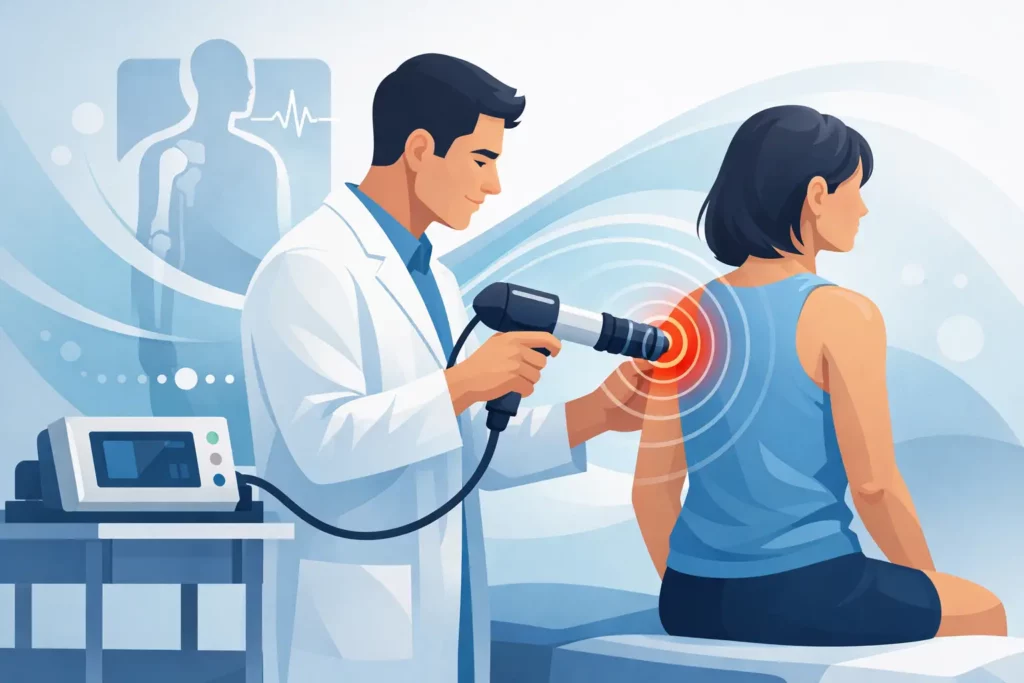
In practice, the clinician places a handheld device over the painful area and delivers a set number of pulses. The aim is to stimulate healing processes, improve local blood flow, and reduce pain over time. It is not usually a one-off fix. Most patients need a short course of treatment, often alongside a wider rehabilitation plan.
That point matters. Shockwave therapy tends to work best when it is part of a precise treatment strategy rather than a standalone add-on. A good assessment comes first, because pain in one area can have more than one cause.
Who tends to benefit most
Shockwave therapy is best known for conditions that are persistent rather than brand new. If you have had symptoms for several weeks or months, and the problem has not fully settled with load management, exercise or manual therapy, it may be a sensible next step.
Common examples include plantar fasciitis, Achilles tendinopathy, patellar tendinopathy, tennis elbow, gluteal tendinopathy and calcific shoulder tendinopathy. Some patients with myofascial trigger points may also benefit, although the evidence is generally stronger for tendon-related problems than for every type of soft tissue pain.
The strongest results usually come when the diagnosis is accurate. Heel pain, for example, is not always plantar fasciitis. Shoulder pain is not always a rotator cuff tendon issue. This is where specialist musculoskeletal assessment can make a major difference. If the wrong structure is treated, even well-delivered shockwave therapy may disappoint.
What the evidence says
A fair shockwave therapy review guide should be honest about this: the research is encouraging for some conditions, mixed for others, and highly dependent on patient selection. Shockwave therapy is not magic, but it is far from a gimmick.
For plantar fasciitis and several tendinopathies, studies have shown meaningful improvement in pain and function, especially where symptoms have become chronic. It can be particularly useful for people who want to avoid more invasive treatment or who have reached a plateau with exercise-based care alone.
That said, outcomes vary. Some patients feel a noticeable difference within a few sessions. Others improve gradually over several weeks after the course has finished. A minority do not respond as hoped. This is why good clinics avoid overpromising. The goal is better healing conditions and pain reduction, not an instant cure.
What treatment feels like
One of the most common questions is whether shockwave therapy hurts. The honest answer is that it can be uncomfortable, especially over a very sensitive tendon or insertion point. Most patients describe it as intense but manageable. The discomfort usually lasts only while the treatment is being delivered.
The session itself is typically short. You may have a consultation first, then the clinician will identify the target area and adjust the settings based on the tissue involved, the chronicity of the problem, and your tolerance. Treatment parameters are not identical for every patient, which is one reason experience matters.
It is also normal to feel some soreness afterwards. That does not usually mean the treatment has gone badly. In many cases, it settles within a day or two. You may be advised to avoid anti-inflammatory medication around the treatment period, depending on your case, because part of the aim is to stimulate a healing response.
Shockwave therapy review guide: the pros and the trade-offs
The main advantage of shockwave therapy is that it is non-surgical and does not require injections or downtime in the way more invasive procedures can. For the right patient, it offers a practical middle ground between basic conservative care and more interventional options.
It can also be valuable when pain has become stubborn enough to affect walking, work, sleep or sport. If the tissue has not responded to an otherwise sensible plan, shockwave may help move recovery forward.
The trade-offs are just as important. It can be uncomfortable during treatment. It often takes more than one session. Results are not guaranteed. It is also not suitable for everyone, including some people with certain medical conditions, local infections, bleeding risks, pregnancy in some treatment areas, or suspected tissue damage that needs a different approach altogether.
This is why a proper assessment is more important than the machine itself. The treatment has a place, but only in the right clinical context.
How it compares with other options
Patients often compare shockwave therapy with steroid injections, physiotherapy, rest or surgery. The right choice depends on the diagnosis, the duration of symptoms, and what has already been tried.
Compared with rest alone, shockwave therapy is generally more active and targeted, but rest still has a role where tissue overload is the main driver. Compared with physiotherapy, it should not be seen as a replacement. Exercise rehabilitation remains central for many tendon problems because tissue capacity needs to improve, not just pain levels.
Compared with steroid injections, shockwave therapy may be preferable in some tendon conditions where repeated steroid use is not ideal. In other cases, ultrasound-guided injection treatment may be more appropriate, especially where inflammation in a specific structure is the main issue and rapid pain control is needed. Compared with surgery, shockwave is much less invasive, but surgery may still be necessary in more advanced or resistant cases.
The best treatment plans are rarely built on a single tool. They combine accurate diagnosis with the right timing and the right sequence of care.
What a good clinic should review before recommending it
Before starting shockwave therapy, a clinician should be clear about what they are treating and why. That includes your symptom history, aggravating factors, previous treatment, activity levels and any red flags. In many cases, imaging may not be essential, but where the diagnosis is uncertain, diagnostic ultrasound can help clarify what is happening in real time.
This matters because persistent pain can come from tendon degeneration, partial tearing, bursitis, nerve irritation, joint pathology or referred pain from elsewhere. Those are not all managed in the same way. At FAB Clinic, this joined-up model of assessment, imaging and treatment planning is central to getting patients to the best route sooner.
A good recommendation should also include what happens around the treatment. You should know whether exercises will change, whether sport needs to be modified, and what progress markers the clinician expects over the next few weeks.
How many sessions are usually needed
A common course is three to six sessions, often spaced about a week apart, though this varies. Some conditions respond well within three sessions. Others need longer, especially if symptoms are longstanding or the tendon has been overloaded repeatedly.
Improvement is not always immediate. Some patients notice early pain relief, while others do not feel much change until several weeks after the final session. That delayed response can be frustrating if you are hoping for quick relief, but it is not unusual.
What matters most is whether the treatment is moving you towards better function. Can you walk further, grip more easily, climb stairs with less pain, or return to sport with better tolerance? Those outcome measures are often more useful than asking whether the painful spot has vanished overnight.
Is it worth the cost?
For many patients, the value question comes down to this: if pain has been limiting work, exercise or sleep for months, a treatment that helps avoid prolonged frustration may be worthwhile. But value is not just about the price per session. It is about whether the therapy is being recommended for the right reason.
A cheaper course that is poorly targeted is poor value. A well-assessed treatment plan that combines shockwave with rehabilitation and, where needed, imaging or other interventions is often the better investment. That is especially true for people who want faster, more accurate insight rather than trial-and-error care.
If you are considering it, ask direct questions. What is the diagnosis? Why is shockwave appropriate here? What are the realistic success rates in a case like yours? What happens if it does not work? Clear answers are usually a sign of sound clinical thinking.
Who should think carefully before booking
Shockwave therapy is not a blanket answer for every painful tendon or joint. If your pain is severe, changing rapidly, linked with marked weakness, numbness, night pain, trauma, or unexplained swelling, a fuller assessment should come first. The same applies if earlier treatment has failed and no one has properly explained why.
It is also worth being cautious if a provider offers shockwave after only a very quick conversation and no meaningful examination. Advanced treatment should follow a diagnosis, not replace one.
If you are considering shockwave therapy, focus less on whether it is popular and more on whether it is appropriate for your specific problem. The best results tend to come when the diagnosis is precise, the treatment is delivered by clinicians who understand musculoskeletal pain in depth, and the plan around it is designed to get you moving well again.