
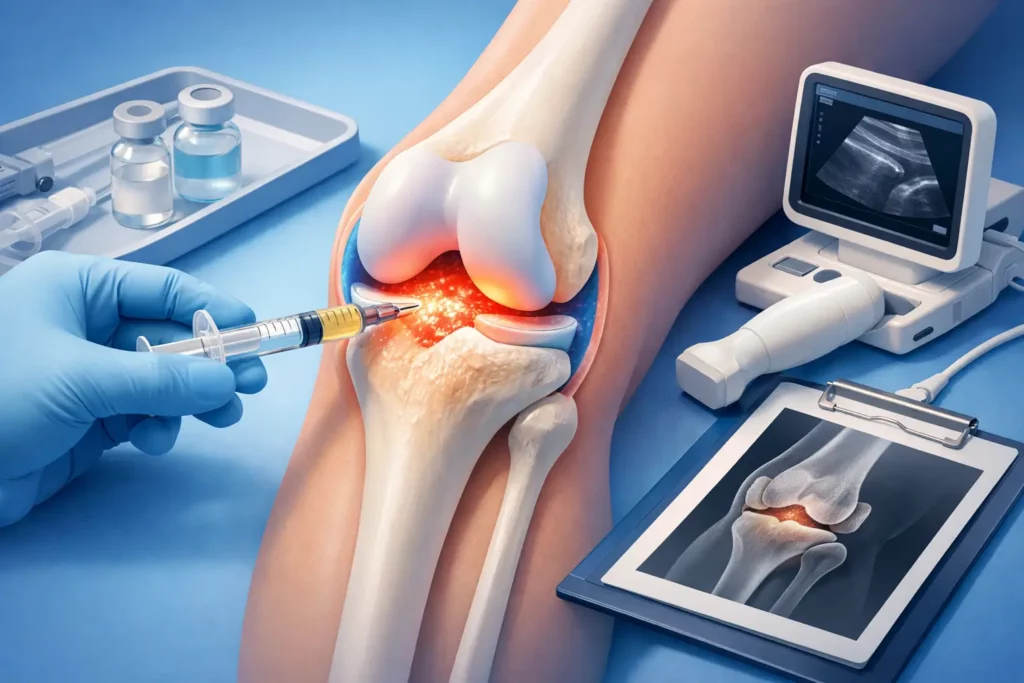
When a painful joint starts limiting sleep, work, exercise, or even simple movement, waiting it out is rarely the best plan. Steroid joint injections are often considered when pain and inflammation are not settling with rest, physiotherapy, or tablets alone, and they can offer targeted relief that helps people move more comfortably and get back to rehabilitation.
What are steroid joint injections?
Steroid joint injections are anti-inflammatory injections placed directly into a painful or inflamed joint. The aim is not to mask a problem without addressing it, but to calm irritation within the joint so pain reduces, movement improves, and the next stage of treatment becomes more effective.
The steroid used is a corticosteroid, which is different from anabolic steroids associated with bodybuilding. In musculoskeletal care, corticosteroids are used because they can reduce inflammation in a focused area. In many cases, a local anaesthetic is also included, which may provide short-term relief soon after the injection while the steroid starts to take effect over the following days.
This treatment can be used for a range of joint problems, including osteoarthritis flare-ups, inflammatory irritation, shoulder pain, knee pain, hip pain, and certain cases of joint swelling where a precise, evidence-based intervention is appropriate.
When are steroid joint injections recommended?
There is no one-size-fits-all answer. The right treatment depends on the joint involved, the cause of pain, how long symptoms have been present, and what has or has not worked already.
In practice, steroid joint injections are usually considered when a patient has clear signs of inflammation or persistent pain that is slowing recovery. That might be a frozen shoulder that is becoming increasingly stiff and painful, a knee joint affected by arthritis that is flaring, or a joint that remains irritated despite a well-managed course of rehabilitation.
They can be especially helpful when pain is blocking progress. If a patient cannot fully participate in physiotherapy, strength work, walking, or day-to-day activity because the joint is too painful, reducing inflammation may create the window needed for proper recovery.
That said, injections are not automatically the first step. In some cases, hands-on therapy, guided exercise, load modification, or other interventions may be more suitable. Good care starts with accurate assessment rather than jumping straight to a procedure.
How the injection works
A steroid injection works by reducing inflammation inside the joint. Less inflammation usually means less pain, less swelling, and improved range of movement. For some patients the change is rapid. For others it is more gradual.
Relief can last for weeks or months, but results vary. Some joints respond very well, while others improve only modestly. The underlying diagnosis matters too. A heavily arthritic joint may not respond in the same way as a mildly inflamed one, and if pain is coming from structures outside the joint, an intra-articular injection may not be the best option.
This is why imaging and clinical examination are so valuable. A precise diagnosis improves the chances of selecting the right treatment, at the right site, for the right reason.
Why image guidance can matter
Accuracy matters with any injection, but especially in deeper or more complex joints. Ultrasound guidance allows the clinician to see the relevant anatomy in real time and place the injection with greater precision.
That can be particularly useful for joints such as the shoulder, hip, or small joints where anatomical variation, swelling, or nearby soft tissues may make landmark-guided injections less exact. It also helps confirm whether the pain source is likely to be inside the joint or related to surrounding tendons, bursae, or soft tissue structures.
For patients, this usually means a more informed procedure, better targeting, and a treatment plan based on fast, accurate insight rather than guesswork.
What happens during the appointment?
A proper injection appointment should begin with assessment, not a needle. Your clinician should review symptoms, examine the joint, consider previous treatment, and decide whether a steroid injection is appropriate and safe.
If the injection goes ahead, the area is cleaned carefully and the medication is placed into the joint, often with ultrasound guidance. The procedure itself is usually quick. Most patients tolerate it well, although some discomfort during or after the injection is possible.
You may be advised to take it easy for a short period afterwards, usually for 24 to 48 hours depending on the joint treated and the broader rehabilitation plan. Rest does not mean stopping all movement. It means giving the joint a brief settling period before returning to guided activity.
How quickly do steroid joint injections work?
Some people notice an initial improvement within a day, especially if local anaesthetic has been used. The steroid itself often takes a few days to start working, and full benefit may not be clear for up to one or two weeks.
A short-lived flare in pain can happen after the injection. This is usually temporary and settles within a couple of days. Ice, relative rest, and following the advice of your clinician are normally enough to manage it.
The important point is that the injection should support recovery, not replace it. Once pain starts to settle, that is often the right time to improve strength, mobility, control, and joint loading with a structured plan.
Benefits and limitations of steroid joint injections
The main benefit is targeted anti-inflammatory treatment. For the right patient, this can mean meaningful pain relief, easier walking, better sleep, improved shoulder movement, or the ability to restart exercise and rehabilitation.
There is also a practical benefit. If pain has become the main obstacle, a well-placed injection can reduce symptoms quickly enough to stop a short-term issue becoming a longer-term cycle of stiffness, weakness, and reduced confidence.
Still, there are limits. Steroid injections do not rebuild worn cartilage, correct poor movement patterns, or replace rehabilitation. They are one part of a wider musculoskeletal treatment plan. Used well, they create an opportunity for progress. Used in isolation, they may offer relief but not a lasting solution.
Are there risks or side effects?
All medical procedures carry some risk, even when they are commonly performed and generally well tolerated. Most side effects after joint injection are mild and short term, such as temporary soreness, a brief pain flare, or facial flushing.
Less common risks include infection, bleeding, skin changes around the injection site, or a limited response to treatment. In people with diabetes, blood sugar levels can rise for a short period after a steroid injection, so this needs to be considered carefully. Repeated injections into the same joint may also not be advisable, depending on the joint, the diagnosis, and the overall treatment strategy.
This is where specialist assessment matters. Safe treatment is not just about how the injection is given. It is about choosing the right patients, the right timing, and the right follow-up plan.
Who may need extra caution?
Steroid joint injections may not be suitable for everyone. Caution is needed if there is active infection, certain medical conditions, use of blood-thinning medication, recent surgery, uncontrolled diabetes, or uncertainty about the true pain source.
Pregnancy, immune-related conditions, and previous poor response to steroid treatment may also influence decision-making. None of these factors automatically rule treatment out, but they do require proper discussion.
A confident clinic should never oversimplify this. The best treatment plan is the one that balances likely benefit with sensible risk management.
What should happen after the injection?
The period after an injection is where good outcomes are often won or lost. If pain reduces, that improvement needs to be used well. For many patients, the next step is physiotherapy or rehabilitation aimed at improving strength, joint control, flexibility, and movement confidence.
That might involve rebuilding shoulder range, improving lower limb strength around an arthritic knee, or correcting loading patterns that have been aggravating the problem. Without that follow-through, symptoms can return because the reasons the joint became overloaded or irritated in the first place have not changed.
This integrated approach is where specialist musculoskeletal clinics can make a real difference. At FAB Clinic, combining assessment, imaging-led diagnosis, injection therapy, and rehabilitation under one roof helps patients move from pain relief to genuine recovery with far more clarity.
Are steroid joint injections right for you?
If your joint pain is persistent, inflamed, and stopping you from moving properly, an injection may be worth considering. If your pain is mainly mechanical, related to instability, or coming from another structure entirely, a different approach may be better.
The key is not to ask whether injections are good or bad in general. The better question is whether this specific injection, in this specific joint, is the right choice for your diagnosis and your recovery plan.
For the right patient, at the right time, steroid joint injections can reduce pain, restore function, and create the space needed for proper rehabilitation. If you have been stuck in the same cycle of pain and limited movement, a specialist assessment can help you move forward with confidence rather than guesswork.