
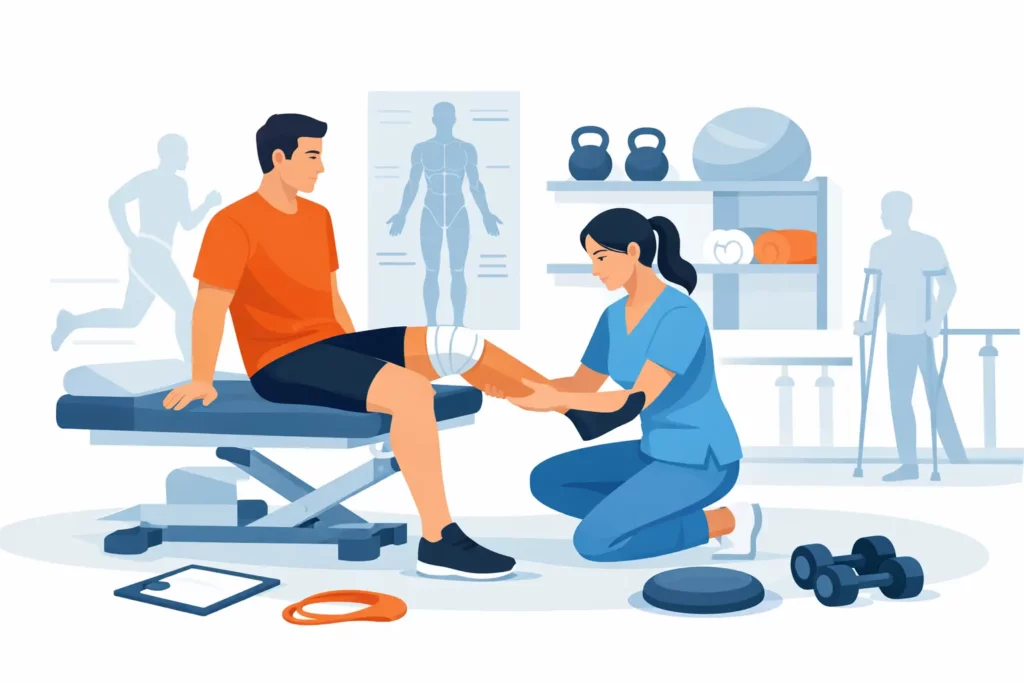
A runner with a calf strain, a padel player with tennis elbow, a cyclist with knee pain – on the surface, these look like different problems. In practice, rehabilitation after sports injury often goes wrong for the same reason: people focus on the painful area, but not on why the injury happened, how the tissue is healing, or what the body needs to return to sport safely.
That is where a structured plan matters. Good rehabilitation is not simply a few exercises pulled from the internet or a wait-and-see approach until pain settles. It is a process built around accurate diagnosis, symptom control, restoring movement, rebuilding strength and confidence, and then progressing back to the demands of training, work and daily life. Done well, it reduces the risk of recurrence and gets you back to doing what you enjoy with a stronger foundation.
Why rehabilitation after sports injury needs more than rest
Rest has a place in the early stages, particularly when pain, swelling or loss of function are significant. But prolonged rest can create new problems. Joints stiffen, muscles weaken, balance drops off, and the nervous system can become more sensitive to movement. For many sports injuries, complete inactivity for too long delays recovery rather than helping it.
The better question is not whether to rest, but how to load the injured area appropriately. A tendon injury, for example, usually needs a carefully graded strengthening programme. A ligament sprain may need support, swelling management and progressive stability work. A muscle tear often improves with the right balance of protection and early guided movement. The detail matters, which is why the first phase of care should always start with a proper assessment.
Start with a precise diagnosis
Not every sports injury is straightforward. A sore shoulder might be a rotator cuff strain, bursitis, joint irritation or referred pain from the neck. Heel pain may be plantar fasciitis, but it could also involve the Achilles tendon, a fat pad issue or a stress reaction. If the diagnosis is off, the treatment plan usually follows in the wrong direction.
A specialist musculoskeletal assessment helps identify which structure is involved, how irritated it is, and which movements or loads are keeping it aggravated. In some cases, diagnostic ultrasound adds fast, accurate insight, particularly for tendon, muscle and soft tissue injuries. This can be especially useful when symptoms are not settling as expected or when there is a need to distinguish between similar-looking conditions.
The value of getting this right early is simple: the clearer the diagnosis, the more targeted the rehabilitation. That often means less wasted time, fewer setbacks and a better outcome overall.
The stages of rehabilitation after sports injury
Most sports injuries improve best through phases rather than a single treatment. The timeline depends on the tissue involved, the severity of the injury, your sport and your general health, but the broad pattern is usually similar.
Phase 1: Calm pain and protect healing tissue
In the early stage, the priority is to reduce excessive irritation without shutting the body down completely. That may include hands-on treatment, activity modification, taping, bracing, or temporary changes to training. If swelling is present, it needs addressing. If walking, lifting or sleeping is difficult, those problems need practical management straight away.
This is also the point where treatment may need to go beyond standard exercise advice. Some patients benefit from soft tissue work, acupuncture, dry needling or hydrotherapy to improve comfort and mobility while the underlying programme gets started. Where pain is severe or persistent, more advanced options such as ultrasound-guided interventions may be considered as part of a wider plan, not as a shortcut in place of rehabilitation.
Phase 2: Restore movement and control
Once pain begins to settle, the next step is restoring movement quality. After injury, the body often develops protective patterns. You may limp slightly, avoid fully bending a joint, grip through the neck and shoulders, or shift weight away from one side. These changes are understandable, but if they persist they can overload other tissues and slow progress.
At this stage, rehabilitation focuses on mobility, joint control, balance and coordination. The exercises may look basic, but they are doing important work. It is not about making a movement possible at any cost. It is about making it efficient, confident and repeatable.
Phase 3: Rebuild strength and tolerance
This is where many people either make real progress or get stuck. Pain has improved, so they assume they are ready to go back to full training. But tissues that no longer hurt are not always tissues that are ready for sport.
Strength, power and load tolerance need to be rebuilt properly. For a hamstring injury, that may mean progressing from isometric work to heavier strengthening and then higher-speed loading. For an ankle sprain, it may include calf strength, single-leg control and landing mechanics. For shoulder injuries, it often requires more than rotator cuff work alone – trunk control, scapular strength and overhead capacity may all need attention.
The right pace matters. Progress too slowly and recovery drags. Push too quickly and symptoms flare. This is why guided progression is so valuable, especially for active adults keen to return as soon as possible.
Phase 4: Return to sport
Returning to sport should be based on function, not just the calendar. You should be able to demonstrate the strength, control, range and confidence your activity demands. A footballer needs different testing from a golfer. A recreational runner has different demands from a CrossFit athlete. The rehabilitation plan should reflect that reality.
A proper return-to-sport phase usually includes sport-specific drills, impact tolerance, change of direction, speed work and workload planning. It should also account for what else is happening in your life. If you are commuting, sitting for long hours, sleeping poorly or carrying a high work stress load, recovery capacity may be lower than expected. Rehabilitation works best when the whole picture is taken seriously.
What can slow recovery down?
A few patterns commonly delay progress. The first is self-diagnosis. What feels like a simple strain can sometimes be a more complex tendon or joint issue. The second is doing too much too soon on good days, then needing several days to settle down again. The third is treating pain relief as the finish line.
There are also cases where symptoms persist because the initial treatment was too narrow. If you only receive manual therapy without a progression plan, relief may be short-lived. If you only do exercises without addressing a highly irritable tendon or inflamed joint, the programme may be too uncomfortable to follow well. The best treatment plans combine accurate assessment with the right therapies at the right time.
When to seek specialist help
Some sports injuries improve quickly with sensible self-management, but others need earlier input. If pain is severe, swelling is significant, there is bruising, instability, locking, weakness, or symptoms are not improving after a short period, it is worth being assessed properly. The same applies if the injury keeps returning or is stopping you from training consistently.
For adults balancing sport with work and family life, delays can be costly. A problem that might have settled within weeks can become a long-running issue if the diagnosis is missed or the rehabilitation lacks direction. This is where an integrated clinic model can make a difference. At FAB Clinic, patients can access specialist physiotherapy alongside imaging-led assessment and a broader range of treatment options when clinically appropriate, helping to keep recovery focused and efficient.
The goal is not just to get rid of pain
The real aim of rehabilitation after sports injury is to restore trust in your body. That means being able to sprint, lift, serve, climb stairs, sleep comfortably, or get through a working day without constantly second-guessing the injured area. It also means understanding what caused the problem and how to reduce the chance of it happening again.
Sometimes that involves technique changes. Sometimes it means improving strength in areas that seemed unrelated. Sometimes it means adjusting training volume, footwear, recovery habits or the way you return after time off. There is rarely a single magic fix. There is, however, a clear route forward when the plan is based on the right diagnosis and progressed with purpose.
If your recovery has stalled, or if you want to avoid turning a short-term injury into a long-term limitation, expert rehabilitation is not an extra. It is the part that gives treatment direction. With the right support, most people can move from pain and uncertainty to a stronger, more confident return to sport – and that is worth doing properly.