
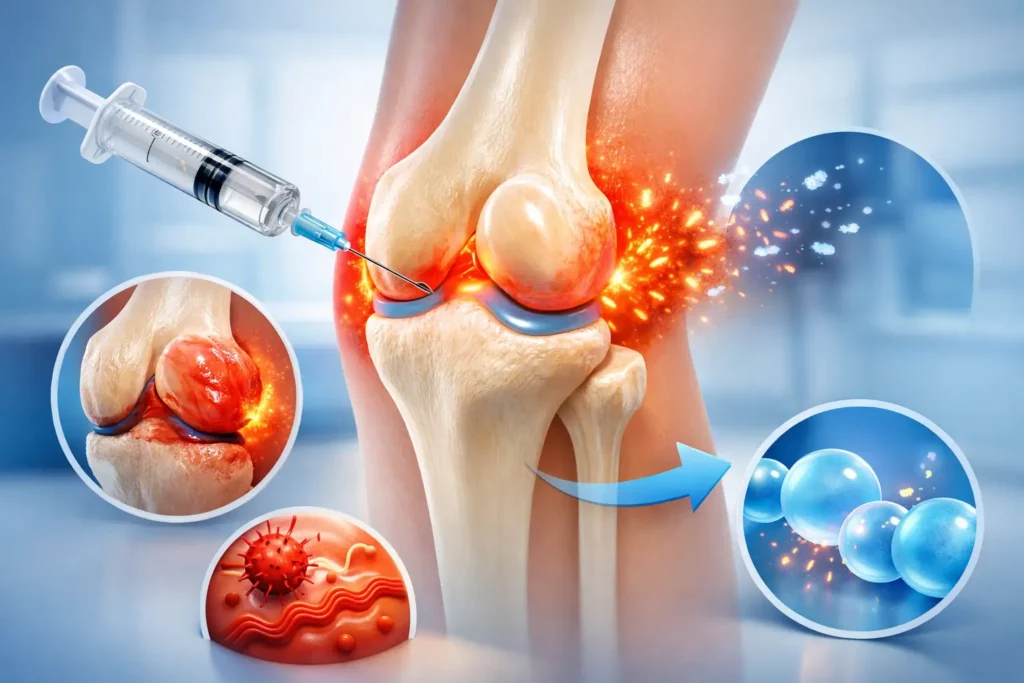
A knee that swells after a short walk, a shoulder that aches every time you reach overhead, or a thumb joint that flares when you grip a kettle – these are the moments when people start asking how joint injections reduce inflammation and whether they could help where rest, tablets, or standard physiotherapy have not done enough.
Joint injections are used to calm irritation inside or around a painful joint. In the right patient, they can reduce pain quickly, improve movement, and create a better window for rehabilitation. They are not a cure for every cause of joint pain, but they can be a very effective part of a broader treatment plan when inflammation is driving symptoms.
How joint injections reduce inflammation in practice
Inflammation is the body’s response to irritation or injury. In a joint, that process can lead to swelling, heat, stiffness, and pain. Sometimes the trigger is osteoarthritis. Sometimes it is an inflammatory flare, overload, a sports injury, or irritation in the lining of the joint itself. Whatever the cause, the end result is often the same: movement becomes painful, muscles tighten to protect the area, and function starts to drop.
Joint injections work by delivering medication directly to the source of the problem. Rather than relying on tablets to circulate through the whole body, the treatment is placed into or around the affected joint where it is needed most. This targeted approach is one reason injections can offer meaningful relief, particularly when symptoms are localised and clearly linked to inflammation.
The most common medication used is corticosteroid, often combined with local anaesthetic. The anaesthetic may provide short-term relief within hours, while the steroid works over the following days to settle the inflammatory response. Corticosteroids reduce the activity of inflammatory chemicals and help limit the swelling and irritation that make movement painful.
When the inflammation settles, the pressure within the joint often reduces as well. That can make everyday actions such as climbing stairs, reaching into a cupboard, standing from a chair, or getting through a working day far more manageable.
Why reducing inflammation matters so much
Pain is rarely the only problem. Once a joint becomes inflamed, people often move less, compensate in awkward ways, and lose confidence in using the area properly. A painful shoulder may lead to poor sleep and weakness. A swollen knee can change your walking pattern and aggravate the hip or back. An arthritic joint in the hand may make dressing, cooking, or typing more difficult.
This is why reducing inflammation matters beyond simple pain relief. When symptoms are brought under control, it is easier to restore normal movement, rebuild strength, and return to activity safely. In clinical practice, the best results often come when an injection is not treated as a standalone fix but as one part of an integrated recovery plan.
That might include physiotherapy, guided exercise, activity modification, and a clearer diagnosis using ultrasound where appropriate. At FAB Clinic, this joined-up model is central to getting patients moving again with fast, accurate insight and a treatment plan that fits the real cause of their symptoms.
Which joints and conditions may respond well?
Joint injections can be useful in several areas of the body. Knees, shoulders, hips, thumbs, ankles and smaller joints in the feet are common examples. They may also help in cases where the inflammation sits in a closely related structure, such as a bursa.
Conditions that may respond include osteoarthritis with inflammatory flares, capsulitis, synovitis, bursitis, and some post-injury joint irritations. For some patients, injections are also considered when pain has limited progress in rehabilitation and there is a clear reason to believe inflammation is blocking recovery.
That said, not every painful joint needs an injection. If the main issue is severe mechanical damage, significant instability, or pain coming from another structure entirely, an injection may offer limited benefit or no benefit at all. This is where a precise assessment matters. The key question is not just where it hurts, but why it hurts.
The role of ultrasound guidance
Accuracy can make a real difference. Ultrasound-guided injections allow the clinician to see the joint and surrounding tissues in real time, which helps place the medication more precisely. That is especially helpful in smaller joints, deeper joints, or cases where nearby tendons, bursae, or other structures could be involved.
Ultrasound also helps confirm what is actually happening. If there is joint lining thickening, fluid, bursitis, or another visible source of irritation, the treatment plan can be tailored more confidently. For patients, that means less guesswork and a clearer rationale for why an injection is being recommended.
What the injection can and cannot do
A joint injection can reduce inflammation, but it does not reverse all underlying joint changes. For example, in osteoarthritis, it cannot regrow worn cartilage. What it can do is reduce the inflammatory component of the pain, settle a flare, and improve function enough for you to move better and engage with rehabilitation.
This distinction matters. Some patients experience excellent relief for weeks or months. Others get shorter-term improvement. A few may not respond as hoped. The result depends on the condition being treated, the accuracy of diagnosis, the stage of the problem, and how well the injection is supported by the right aftercare.
That is why expectations need to be realistic. A good clinician should explain the likely benefit, the limits of treatment, and what comes next if symptoms improve only partly.
What to expect after treatment
Most joint injections are quick procedures. The area is assessed, the skin is cleaned carefully, and the medication is delivered using a fine needle. If ultrasound guidance is used, you can usually watch the process on screen if you want to. Many patients describe it as uncomfortable rather than painful, and the procedure is generally well tolerated.
Afterwards, the joint may feel temporarily numb or easier to move because of the local anaesthetic. Some people then notice a mild flare for a day or two before the steroid starts to take effect. Improvement often begins within a few days, although for some it takes a little longer.
You are usually advised to avoid heavy loading for a short period, then reintroduce activity sensibly. This phase matters. If pain eases, it is tempting to do too much too soon. The better approach is to use the relief as an opportunity to rebuild strength, improve joint mechanics, and address the factors that led to the problem in the first place.
Are there trade-offs or risks?
Yes, and they should be discussed properly. Joint injections are generally safe when carried out by qualified clinicians with the right assessment and sterile technique, but no procedure is completely risk-free.
Potential side effects can include temporary pain after the injection, skin changes, flushing, a rise in blood sugar in people with diabetes, and in rare cases infection or bleeding. Repeated steroid injections into the same area are not always appropriate, particularly if done too frequently. There are also situations where an injection should be delayed or avoided, such as active infection, certain medication issues, or uncertainty about the diagnosis.
This is why careful patient selection is essential. The goal is not to inject every painful joint. The goal is to identify when an injection is the best treatment at that stage of recovery.
When is the right time to consider one?
Usually, a joint injection is considered when pain and inflammation are significant enough to limit daily life, sleep, work, or rehabilitation, and when simpler measures have not provided enough relief. It can also be helpful when a flare is stopping progress and a more decisive intervention is needed.
For some patients, earlier treatment makes sense because it prevents a longer cycle of reduced mobility and compensation. For others, conservative care remains the right first step. It depends on the diagnosis, severity, duration of symptoms, and your wider recovery goals.
A specialist assessment should look at the whole picture: what structure is involved, whether the pain is truly inflammatory, what has already been tried, and what the plan will be after the injection. That is where patients often feel the biggest difference between generic care and specialist musculoskeletal treatment.
If a joint has been keeping you from walking comfortably, sleeping properly, exercising, or simply getting through the day without guarding every movement, a targeted injection may be the step that settles inflammation enough for real progress to begin. The important thing is not just getting pain relief, but using that relief to move forwards with confidence and a clear recovery plan.