
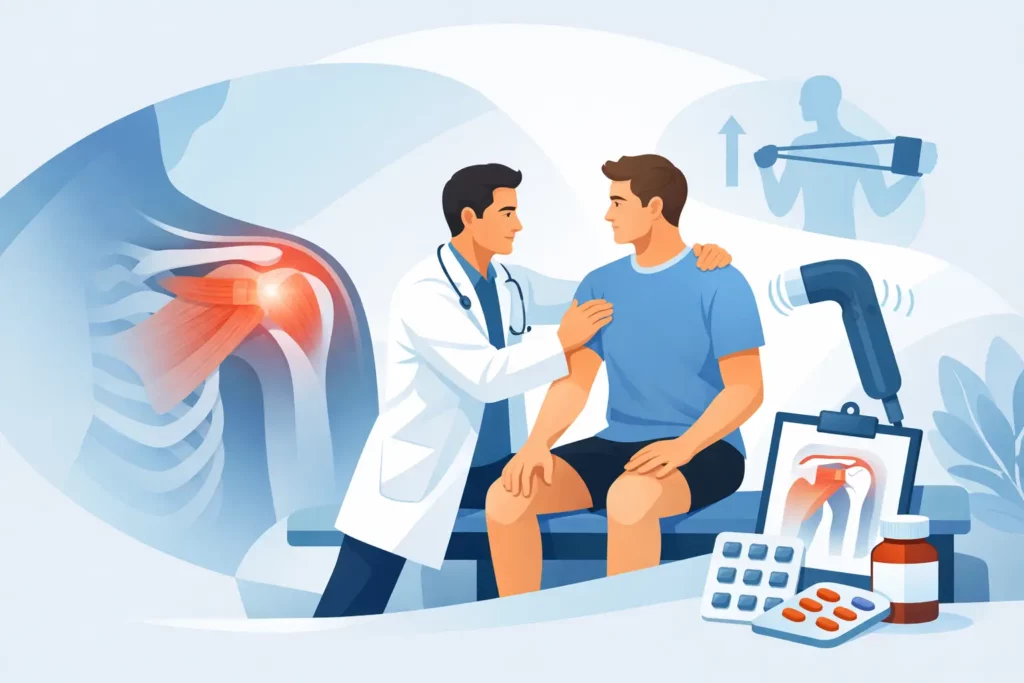
Shoulder pain rarely stays neatly in the shoulder. It creeps into sleep, makes dressing awkward, turns reaching overhead into a sharp reminder, and can quickly affect work, exercise and day-to-day confidence. Effective rotator cuff injury treatment is not just about settling pain. It is about identifying what is actually injured, why it happened, and what will give you the best chance of a strong, reliable recovery.
What the rotator cuff actually does
The rotator cuff is a group of four muscles and their tendons that help stabilise the shoulder and control movement. These tissues work hard every time you lift your arm, reach behind you, carry shopping, swim, throw, or even position your arm at a desk. Because the shoulder has such a wide range of movement, it relies heavily on the rotator cuff for support.
When one or more of these tendons becomes irritated, overloaded or torn, the result can range from a mild ache to significant weakness and loss of function. Some people notice pain gradually building over weeks. Others feel a sudden catch or tear during lifting, sport or a fall.
Signs you may need rotator cuff injury treatment
Not every sore shoulder is a rotator cuff problem, but there are some common patterns. Pain is often felt over the outer shoulder or upper arm. Lifting the arm out to the side can feel painful or weak. Reaching into a cupboard, fastening a bra, putting on a coat or lowering the arm from overhead may be especially uncomfortable.
Night pain is another frequent complaint. If lying on the affected side wakes you, or your shoulder throbs after a busy day, the rotator cuff may be involved. Some patients also report clicking, catching or the feeling that the shoulder is simply not working properly.
A proper assessment matters because similar symptoms can also come from bursitis, frozen shoulder, arthritis, neck-related pain or biceps tendon irritation. That is where specialist musculoskeletal assessment can make a real difference.
Rotator cuff injury treatment starts with the right diagnosis
The best treatment plan depends on what type of injury you have. Tendinopathy, bursitis, partial tears and full-thickness tears can all sit under the umbrella of shoulder pain, but they do not behave in exactly the same way.
Clinical examination gives valuable information about pain patterns, strength, movement and function. In some cases, diagnostic ultrasound provides fast, accurate insight into the state of the tendons and surrounding structures. This can help confirm whether the issue is inflammatory, degenerative, traumatically torn, or part of a broader shoulder problem. It also helps guide decisions about whether rehabilitation alone is appropriate or whether more targeted intervention is needed.
That matters because generic advice to “rest it and see how it goes” often leads to frustration. Too little loading can leave the shoulder weaker and stiffer. Too much too soon can keep the tendon irritated. Precision is what gets recovery moving in the right direction.
Early treatment focuses on pain, movement and protection
In the early stage, the aim is usually to calm the shoulder without allowing it to seize up. Complete rest is rarely the answer unless a serious acute tear or fracture is suspected. Most patients do better with relative rest, which means modifying aggravating activity while keeping the joint moving within tolerable limits.
Hands-on physiotherapy can help reduce pain and improve movement around the shoulder, neck and upper back. If the shoulder blade is stiff or poorly controlled, that often feeds into rotator cuff overload. Gentle mobility work, postural correction and carefully chosen exercises usually begin early.
Pain relief may also involve simple measures such as activity pacing, ice or heat depending on the presentation, and advice on sleeping position. In more irritable cases, particularly where inflammation in the bursa is driving pain, a more interventional approach may be considered.
Rehabilitation is the core of rotator cuff injury treatment
For most rotator cuff injuries, rehabilitation is the main driver of long-term improvement. The goal is not simply to make the shoulder feel better for a week. It is to restore strength, control and tolerance so the shoulder can cope with real life again.
Early exercises often target gentle range of movement and low-level isometric loading to maintain muscle activity without provoking a flare-up. As pain settles, the programme usually progresses towards strengthening the rotator cuff itself, improving shoulder blade mechanics, and rebuilding the capacity of the surrounding muscles.
This stage needs judgement. Some patients need slower progression because the tendon is reactive and easily aggravated. Others need more challenge because underloading has become part of the problem. Office workers may need support with workstation habits and repeated reaching tasks. Active patients may need sport-specific loading so they can return to tennis, gym work or swimming without relapse.
The strongest rehab plans are tailored, reviewed and progressed. That is particularly important if symptoms have been present for months, because persistent shoulder pain often involves both tissue irritation and altered movement patterns.
When advanced treatment options can help
Not every patient improves with exercise alone, especially when pain is limiting progress. In these cases, integrated musculoskeletal care offers more than a standard one-size-fits-all approach.
Ultrasound-guided injection therapy may be appropriate for selected patients when inflammation is significant, night pain is severe, or rehabilitation is being blocked by pain. Used properly, an injection is not a shortcut that replaces exercise. It is a tool that can reduce pain and create a window for more effective rehabilitation.
Extracorporeal shockwave therapy may also have a role in certain tendon conditions, particularly where chronic tendon pain or calcific change is involved. It is not suitable for every shoulder problem, but in the right case it can support healing and symptom reduction.
Acupuncture, dry needling and soft tissue work can also be useful adjuncts for pain relief and muscle tension, especially where the upper trapezius, neck or chest muscles have become overactive in response to the shoulder injury. The key is using these treatments to support a broader recovery plan rather than treating them as standalone fixes.
When surgery might be considered
Many rotator cuff problems improve without surgery, but not all. A traumatic full-thickness tear, marked weakness after an injury, or failure to progress with well-managed conservative care may justify surgical opinion.
Age, activity demands, tear size, tissue quality and function all matter. A younger active patient with a significant acute tear may be managed very differently from an older adult with degenerative tendon changes and manageable pain. This is one of those situations where “it depends” is the honest answer.
What patients often need most is clarity. If surgery is unlikely to add meaningful benefit, that should be explained confidently. If it may be the best route, delaying too long is not always helpful either. Good care means knowing when to rehabilitate, when to escalate, and when to refer.
Why some shoulder injuries keep coming back
Recurring rotator cuff pain is often less about bad luck and more about incomplete recovery. Pain may settle before the tendon has regained enough strength and load tolerance. People return to lifting, decorating, gardening or sport because the shoulder feels “better”, but the underlying capacity is still not there.
Technique also matters. Poor shoulder blade control, restricted thoracic mobility, deconditioning, and sudden spikes in training load can all contribute. For some patients, work demands are the main driver. Repeated overhead activity, long hours at a computer, or manual handling without enough recovery can keep the tendon under strain.
This is why strong rotator cuff injury treatment looks beyond the site of pain. It addresses how the whole shoulder complex moves and what your daily life is asking it to do.
What to expect from recovery
Recovery times vary. Mild tendon irritation may improve over a matter of weeks, while more established tendinopathy or partial tears can take several months to fully settle. Progress is rarely perfectly linear. It is common to have good weeks and then a flare-up after overdoing things.
That does not necessarily mean damage is getting worse. More often, it means the shoulder has been pushed beyond its current capacity and the programme needs adjusting. This is where expert follow-up is valuable. Small changes in exercise dosage, movement strategy or pain management can prevent a temporary setback becoming a longer delay.
At FAB Clinic, that joined-up approach matters. Combining specialist assessment, imaging-led diagnosis and targeted rehabilitation helps patients move from uncertainty to a clear plan with the best chance of lasting improvement.
When to seek help promptly
If you cannot lift your arm after a fall, have sudden significant weakness, severe night pain that is not easing, or symptoms that are steadily worsening, it is worth getting assessed sooner rather than later. The same applies if your shoulder pain has dragged on for weeks and standard advice has not worked.
Fast, accurate diagnosis can save time, reduce frustration and point you towards the right treatment pathway earlier. That is often the difference between a shoulder problem that lingers and one that is managed properly.
The good news is that most people with rotator cuff pain can improve with the right combination of diagnosis, pain relief and progressive rehabilitation. The sooner the plan fits the actual problem, the sooner your shoulder can start doing its job again – and you can get back to yours.