
That sharp, first-step pain under the heel can change the way you move through the whole day. Shockwave therapy for plantar fasciitis is often considered when rest, stretching, insoles and standard physiotherapy have not brought enough relief, and for many patients it offers a practical next step before more invasive treatment is considered.
Plantar fasciitis is one of the most common causes of heel pain. Despite the name, it is not always a straightforward inflammatory problem. In many persistent cases, the tissue under the foot is irritated, overloaded and slow to heal. That matters, because the right treatment plan is not just about calming symptoms for a week or two. It is about improving how the tissue recovers and reducing the strain that keeps the problem going.
What plantar fasciitis actually is
The plantar fascia is a thick band of tissue running along the sole of the foot, connecting the heel to the toes. It helps support the arch and absorb force when you walk, run or stand for long periods. When this tissue becomes overloaded, small areas of degeneration and irritation can develop, usually close to the heel.
Most people describe pain at the bottom of the heel, often worse with the first few steps in the morning or after sitting down. It may ease as the foot warms up, then return later in the day after prolonged standing, commuting or exercise. For some, it starts after a change in training. For others, it builds gradually with no single obvious trigger.
The reasons vary. Tight calf muscles, reduced ankle mobility, footwear, long hours on hard floors, changes in activity levels, weight gain and foot mechanics can all play a part. This is why a good assessment matters. The heel may be painful, but the cause is rarely just the heel itself.
When shockwave therapy for plantar fasciitis is used
Shockwave therapy is not usually the first thing someone needs the moment heel pain starts. Many recent cases improve with a combination of activity modification, tailored exercises, manual therapy, footwear advice and time. However, when symptoms have been present for several weeks or months, or when progress has stalled, shockwave can become a very useful option.
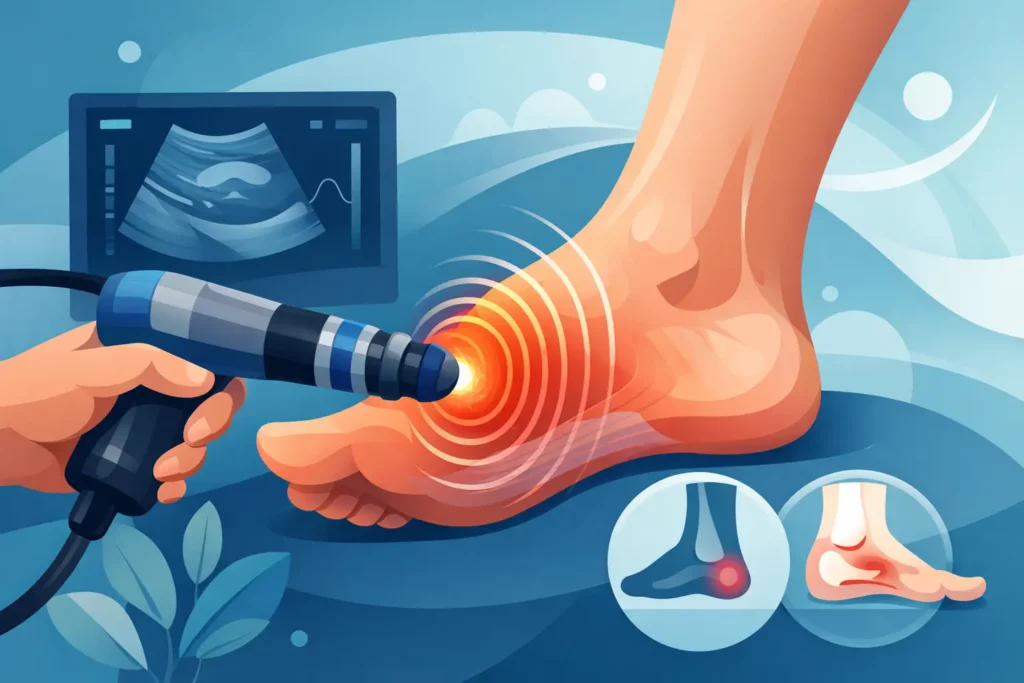
Extracorporeal shockwave therapy uses acoustic waves delivered through the skin to the painful area. The aim is to stimulate a healing response in tissue that has become stubborn and slow to recover. It can also help reduce pain sensitivity in the area. In practical terms, that means it is often used for plantar fasciitis that has become persistent rather than for a short-lived flare-up.
At a specialist musculoskeletal clinic, shockwave therapy works best as part of a broader treatment plan. If the fascia is being repeatedly overloaded by poor calf strength, stiff ankles or an abrupt return to running, treating the tissue alone may not be enough. The best outcomes usually come from combining symptom relief with a clear plan to address the reason it developed.
How shockwave therapy works
The treatment is delivered using a handheld device placed against the skin over the painful part of the heel or plantar fascia. Gel is applied first, and the clinician adjusts the settings according to the area being treated and your tolerance. The session itself is relatively quick.
Patients often ask whether it is meant to break something up. In plantar fasciitis, that is not really the point. The purpose is to stimulate the body’s repair processes and influence pain pathways in tissue that has become chronically irritated. There is evidence that shockwave can encourage improved blood flow and cellular activity in tendon and fascia-related conditions, which is why it is commonly used in sports medicine and specialist MSK practice.
It is not a magic fix, and it does not replace rehabilitation. What it can do is help move a stalled condition in the right direction so that exercise and loading strategies become more effective.
What treatment feels like
Shockwave therapy is often uncomfortable rather than unbearable. Most patients feel a tapping or pulsing sensation over the painful area, and because the heel is already sensitive, the treatment can be quite intense at first. That said, the settings can be adjusted, and a skilled clinician will work at a level that is therapeutic but manageable.
A session usually lasts only a few minutes for the shockwave element itself. Some people notice a temporary increase in soreness afterwards, while others feel little reaction until the following day. Mild irritation for a short period is not unusual. You are typically able to walk out afterwards and continue with normal daily activity, although high-impact exercise may need to be modified depending on your overall plan.
How many sessions are usually needed
A single session is rarely the full answer. Most treatment plans involve a short course, often around three sessions spaced over several weeks, though the exact number depends on symptom duration, severity and how the tissue responds.
This is one of the reasons expectations need to be realistic. Improvement is often gradual rather than immediate. Some patients notice a change after the first or second session, but for others the main benefit appears later as the tissue settles and strengthening work starts to have more effect. If someone is hoping for overnight relief, shockwave may feel underwhelming. If they are looking for a clinically sound way to support healing in a stubborn case, it can be highly worthwhile.
Who is most likely to benefit
Shockwave therapy tends to be most useful for people with plantar fasciitis that has not improved enough with first-line care. That may include working professionals who are on their feet all day, runners trying to return to training, or adults whose heel pain has lingered for months despite stretching and insoles.
It can be especially helpful when scans or clinical assessment suggest a degenerative, overloaded fascia rather than a short-term inflammatory flare. This is where fast, accurate insight makes a difference. Heel pain can also be caused by other issues, including fat pad irritation, nerve involvement or referred pain from elsewhere. If the diagnosis is wrong, the treatment plan is likely to disappoint.
There are also cases where shockwave is not the best fit. If the pain is very new, if there is a suspected tear, or if another structure is responsible, a different approach may be more appropriate. Certain medical factors may also affect suitability, which is why proper screening matters before treatment begins.
Why diagnosis matters before treatment
Persistent heel pain is easy to label and easy to mistreat. Many patients arrive having already tried online exercises, generic insoles and weeks of hoping it will settle on its own. Sometimes it does. Sometimes it simply becomes more entrenched.
A specialist assessment looks at more than the sore spot. It should consider walking pattern, calf strength, ankle range, training load, work demands and whether the pain pattern truly matches plantar fasciitis. In some clinics, diagnostic ultrasound can add another layer of clarity by showing changes in the fascia and helping rule out other causes of pain.
This joined-up approach is particularly valuable when progress has been slow. Rather than repeating the same advice with diminishing returns, it allows treatment to be more precise. That may mean shockwave therapy, or it may mean a different intervention supported by hands-on care and rehabilitation.
What else should be included with shockwave therapy for plantar fasciitis
Shockwave works best when it is not used in isolation. A strong treatment plan usually includes targeted calf and foot strengthening, mobility work where needed, load management and footwear advice. Some patients need help reducing strain at work. Others need a structured return to sport so the fascia is challenged enough to recover, but not so much that it is repeatedly aggravated.
This is where integrated care has real value. If pain is severe, if gait has changed significantly, or if there are multiple contributing factors, combining shockwave with specialist physiotherapy can produce better results than relying on one treatment alone. At FAB Clinic, that focus on accurate diagnosis and evidence-based recovery planning is central to getting patients moving with more confidence.
Is it worth it?
For the right patient, yes. Shockwave therapy is well established in the treatment of persistent plantar fasciitis and can offer meaningful pain relief without injections or surgery. The key phrase is for the right patient. It is not the answer to every sore heel, and it is not a substitute for a proper diagnosis or a well-built rehab programme.
What makes it valuable is that it fills an important gap. It sits between basic self-management and more invasive options, giving patients with stubborn heel pain a treatment that is targeted, evidence-based and compatible with an active recovery plan.
If your heel pain has been dragging on, the most helpful next step is rarely more guesswork. It is a clear assessment, a precise diagnosis and a treatment plan that gives the tissue a genuine chance to heal so each morning starts with less pain and more confidence.