 Skip to content
A painful first step out of bed, a shoulder that hurts every time you reach overhead, or an Achilles tendon that will not settle can make even simple movement feel uncertain. If you are weighing up treatment options, this shockwave review explains where extracorporeal shockwave therapy can help, what a course involves, and why an accurate diagnosis should come before any treatment begins.
Shockwave therapy is not a quick fix for every painful joint or tendon. It is, however, a well-established non-surgical treatment that can be particularly useful for certain stubborn tendon conditions when a structured rehabilitation plan has not delivered sufficient progress. The right treatment depends on the tissue involved, the duration of your symptoms, your activity demands and any underlying joint problem that may be contributing to pain.
What is shockwave therapy?
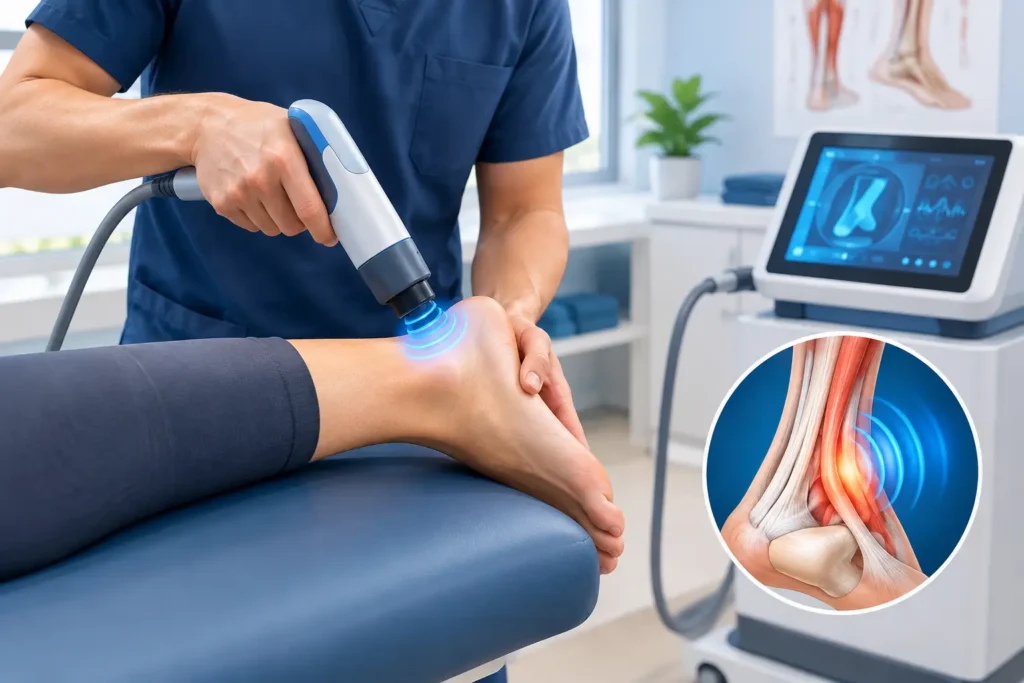
Extracorporeal shockwave therapy, often shortened to ESWT, uses a handheld device to deliver focused or radial acoustic pressure waves into the affected area. Despite the name, these are not electric shocks. The treatment is designed to stimulate biological processes in painful tissue and can support the body’s healing response.
In tendinopathy, pain can persist because the tendon has not adapted well to repeated loading. Shockwave therapy may help by influencing local circulation, nerve sensitivity and tissue remodelling. It is usually used alongside targeted exercises, load management and hands-on rehabilitation, rather than as a replacement for them.
At FAB Clinic, shockwave therapy sits within a broader musculoskeletal treatment plan. That matters because treating the point of pain without assessing movement, strength and the surrounding joints can leave the original driver of the problem untouched.
Shockwave review: where treatment is most effective
The strongest clinical use for shockwave therapy is in persistent tendon and fascia pain, particularly where symptoms have lasted for several months. Many people seek it after rest, anti-inflammatory medication, insoles or standard physiotherapy have provided only limited relief.
It is commonly considered for plantar fasciitis, Achilles tendinopathy, tennis elbow, golfer’s elbow, calcific shoulder tendinopathy and greater trochanteric pain syndrome around the outside of the hip. It may also be recommended for patellar tendon pain and selected cases of hamstring or gluteal tendinopathy.
Results vary by condition. For example, someone with plantar fasciitis that causes sharp heel pain on their first steps in the morning may respond very differently from a runner with a long-standing insertional Achilles problem. Calcific deposits in the shoulder can be another distinct situation: imaging may show whether shockwave is suitable or whether a different intervention is more likely to bring relief.
A good clinical review should avoid blanket promises. Shockwave therapy can reduce pain and improve function, but it does not repair every tendon problem and it will not correct a significant tear, advanced arthritis or pain referred from the spine. Fast, accurate insight is essential before committing to a course.
Why diagnosis changes the plan
Tendon pain is often named according to where it hurts, not necessarily where the problem starts. Lateral elbow pain, for instance, may involve the tendon itself, the neck, altered grip mechanics or a combination of factors. Similarly, heel pain is not always plantar fasciitis.
A specialist assessment considers your history, symptoms, range of movement and strength. Diagnostic ultrasound can add valuable detail by identifying tendon thickening, inflammation around the tendon, calcification, bursitis or a partial tear. This helps ensure shockwave is directed at the right target and used only when it supports the best treatment plan.
What does a shockwave session feel like?
A clinician applies gel to the skin and moves the treatment head over the painful tissue. The pulses create a tapping or rapid knocking sensation. The intensity is gradually adjusted to a level that is therapeutic but tolerable.
Some discomfort during treatment is normal, especially where a tendon is sensitive. Most sessions are short, often around 10 to 15 minutes. You can normally walk out afterwards and return to everyday activities, although strenuous exercise may need to be modified for a short period depending on the condition being treated.
A typical course may involve three sessions spaced about a week apart, although the number and timing are individual. Improvement is rarely instant. Some people notice a change after the first or second session, while others experience temporary soreness before gradual gains over the following weeks. Tendons remodel slowly, so the rehabilitation programme remains just as important after the treatment room appointment ends.
The benefits and limits to weigh up
The principal benefit is that shockwave is non-invasive. There is no incision, no general anaesthetic and usually no significant downtime. For appropriate chronic conditions, it can offer a useful next step before considering more invasive options.
It also fits well with progressive rehabilitation. As pain settles, a physiotherapist can build strength, improve control and guide your return to walking, work, sport or training. This combination gives the tendon a better chance of tolerating the demands that caused symptoms to persist in the first place.
The trade-off is that treatment requires patience and active participation. Shockwave on its own is less likely to produce a lasting result if you immediately return to the same overload pattern, or if the tendon has not regained enough strength. For an active person, this may mean temporarily adjusting running mileage, court sport, hill walking or gym loading while remaining as active as safely possible.
It is also not always the first treatment to choose. Acute injuries, substantial tears, severe inflammatory flare-ups and pain arising from a different source may need another approach. In some cases, ultrasound-guided injection treatment, manual therapy, acupuncture, medication review or a more specific rehabilitation plan may be more appropriate.
Is shockwave therapy safe?
Shockwave therapy is generally well tolerated when delivered after a proper assessment. Common short-term effects include local redness, tenderness, mild bruising or a temporary increase in pain. These effects usually settle quickly.
There are circumstances in which treatment may not be suitable. Your clinician should know about pregnancy, bleeding disorders, anticoagulant medication, cancer in or near the treatment area, infection, reduced sensation and any history of recent steroid injection around the tendon. The precise restrictions can depend on the device used and the area being treated.
Do not assume that more intensity is better. The aim is not to endure unnecessary pain, but to provide a dose that is clinically appropriate for the condition and your tolerance. A reputable provider will explain expected sensations, review your response at each session and adapt the plan when needed.
Who is most likely to benefit?
Shockwave therapy is often worth discussing if pain has persisted for more than three months, conservative treatment has stalled and your diagnosis points to a suitable tendon or fascia problem. It can be a particularly practical option for people who want to stay mobile and avoid a prolonged cycle of rest and flare-ups.
The best candidates are usually prepared to combine treatment with rehabilitation. That does not mean pushing through severe pain. It means following a measured programme that restores capacity over time, with clear guidance on what you can continue, what to reduce and when to progress.
If your pain is severe at night, follows a major injury, comes with marked swelling, weakness, fever, unexplained weight loss or neurological symptoms, seek prompt medical assessment rather than booking shockwave treatment on the assumption that it is a routine tendon problem.
Questions to ask before booking
Before starting a course, ask what diagnosis is being treated, whether imaging would improve decision-making, how shockwave fits with rehabilitation and what improvement would realistically look like. You should also understand the likely number of sessions, the expected cost and the point at which the plan will be reviewed if your symptoms are not improving.
The most useful shockwave review is not simply whether a device works. It is whether the treatment is right for your body, your diagnosis and the life you want to return to. When the assessment is precise and the rehabilitation is progressive, shockwave can be a valuable part of getting you moving with greater confidence again.
