
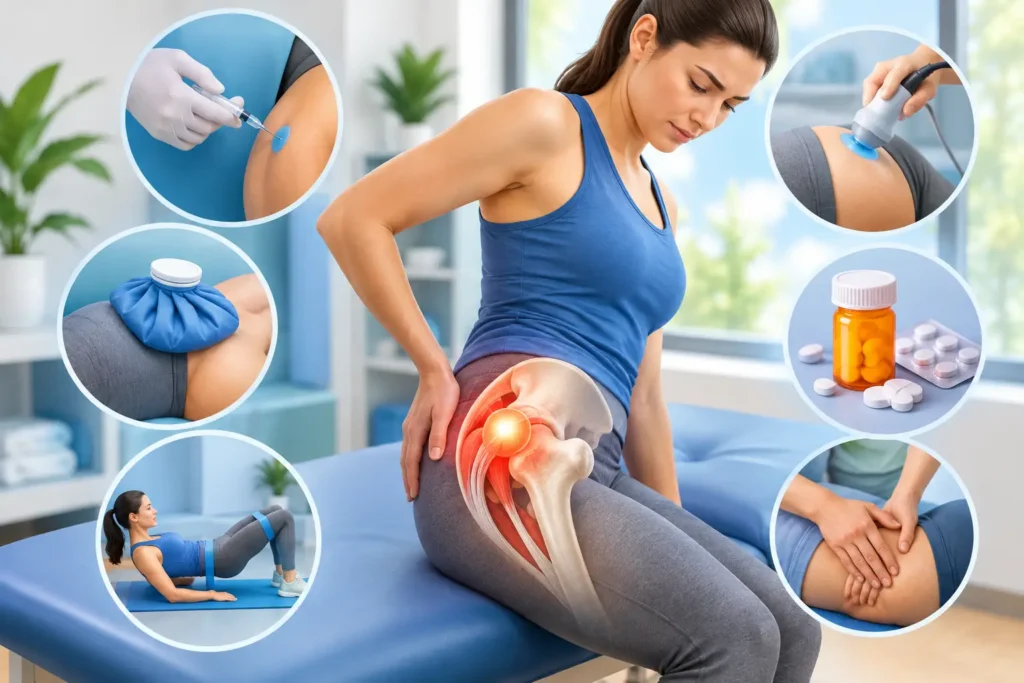
That sharp ache on the outside of your hip can make lying on one side, climbing stairs or getting out of the car unexpectedly difficult. The best treatments for hip bursitis are not simply about reducing inflammation for a few days. They identify why the outside of the hip has become sensitive, settle pain and rebuild the strength and movement control needed to stop it returning.
Hip bursitis is often used to describe pain around the bony point at the top of the thigh bone, known as the greater trochanter. However, the condition is frequently part of a broader problem called greater trochanteric pain syndrome. The bursa may be irritated, but the gluteal tendons and muscles that support the pelvis are commonly involved too. That distinction matters because treatment should address the whole area, not just the painful spot.
First, get the diagnosis right
Outer hip pain is not always bursitis. Gluteal tendon irritation, arthritis in the hip joint, pain referred from the lower back and, less commonly, a stress fracture can produce similar symptoms. A thorough assessment considers where the pain is felt, what triggers it, hip and back movement, walking pattern, muscle strength and relevant medical history.
Diagnostic ultrasound can provide fast, accurate insight into the soft tissues around the hip. It may show bursal swelling, tendon changes or other features that help guide treatment. Imaging is useful when symptoms have persisted, pain is severe or a patient has not responded as expected, but it should support a clinical assessment rather than replace one. Scan findings do not always match the level of pain a person feels.
Seek urgent medical advice if hip pain follows a significant fall, you cannot bear weight, the joint is hot and swollen, you feel unwell or feverish, or pain is severe and rapidly worsening. These features need prompt assessment rather than a self-managed treatment plan.
Best treatments for hip bursitis: a tailored plan
The most effective plan usually combines sensible load modification, progressive rehabilitation and targeted pain relief where needed. The right balance depends on how long symptoms have been present, the demands of your work or sport, and whether tendon involvement is also present.
Reduce irritation without stopping all activity
Complete rest can make the muscles around the hip weaker and leave the area less able to cope when normal activity resumes. Instead, the goal is to temporarily reduce the movements and positions that repeatedly compress or overload the outer hip.
For many people, this means avoiding lying directly on the painful side and placing a pillow between the knees when lying on the other side. Try not to stand with one hip pushed out to the side, cross your legs for long periods or repeatedly climb steep hills and stairs while symptoms are aggravated. Shorter walks on flatter ground may be more manageable during the early phase.
Ice can provide short-term relief after an aggravating activity. Some people find warmth more comfortable before gentle movement. Neither changes the underlying cause, but both can be useful tools alongside rehabilitation. Anti-inflammatory medication may also help some patients, provided it is suitable for their health and prescribed or advised appropriately by a pharmacist or clinician.
Physiotherapy to restore hip strength and control
Targeted physiotherapy is central to lasting recovery. The gluteal muscles need to stabilise the pelvis every time you walk, climb, run or stand on one leg. When these muscles are weak, poorly coordinated or suddenly exposed to more load than they can tolerate, the tendons and bursa on the outside of the hip can become painful.
A programme should begin at the level your hip can manage. This may include gentle isometric exercises, controlled hip strengthening and work on balance, walking mechanics and pelvic control. It then progresses towards functional tasks such as stairs, longer walks, gym training or sport-specific movement.
The trade-off is that improvement is rarely instant. A well-designed programme can reduce pain and improve confidence within weeks, but tendon-related symptoms often need consistent loading over several months. Pushing through sharp pain or jumping too quickly to high-impact exercise tends to delay recovery. Equally, exercises that are far too easy will not build enough capacity.
Hands-on treatment, including soft tissue work or joint mobilisation, may help ease discomfort and improve movement for selected patients. It is most valuable when it supports an active rehabilitation plan, not when it becomes the only treatment.
Shockwave therapy for persistent tendon-related pain
Extracorporeal shockwave therapy may be considered when outer hip pain has persisted despite appropriate rehabilitation, particularly where assessment suggests gluteal tendinopathy. The treatment delivers acoustic waves to the affected area with the aim of stimulating tissue repair and reducing pain sensitivity.
Shockwave is not a shortcut around exercise. It is generally most effective when combined with a progressive strengthening programme and a plan to manage aggravating loads. Treatment can be uncomfortable during delivery and temporary soreness afterwards is possible. It is also not appropriate for everyone, so a clinician should review your medical history and diagnosis first.
Ultrasound-guided injections when pain is blocking progress
If pain is preventing sleep, walking or meaningful rehabilitation, an ultrasound-guided injection may be an appropriate option. Ultrasound helps the clinician place treatment accurately around the relevant bursa or tendon region, rather than relying on surface landmarks alone.
A corticosteroid injection can reduce inflammation and pain quickly for some patients, particularly in an acute flare. This may create an important window in which they can sleep better, move more comfortably and begin rehabilitation. However, its benefit can be temporary, and repeated steroid injections around tendons may not be the best long-term strategy. The decision should be based on the diagnosis, duration of symptoms and your wider health picture.
Other injection options may be discussed in specialist settings, but no injection replaces the need to improve hip capacity. The strongest results tend to come when pain relief is used to support, rather than postpone, rehabilitation.
Everyday changes that protect the outside of the hip
Small changes can make a meaningful difference while the hip settles. If a desk-based role involves long periods of sitting, stand and move regularly rather than remaining in one position for hours. If you carry a child, heavy bag or equipment on one side, alternate where possible. Runners may need to reduce mileage, avoid cambered roads temporarily and reintroduce speed or hills gradually.
Body weight can affect the load through the hips, but hip bursitis is not simply a weight problem. The priority is a realistic plan that improves movement and activity tolerance without blame. Sleep, stress and recovery also influence how persistent pain is experienced, particularly when symptoms have disrupted life for months.
When surgery is considered
Surgery for hip bursitis is uncommon. It is usually reserved for persistent, disabling pain that has not improved after a substantial period of well-delivered non-surgical care, and only after the diagnosis has been carefully reviewed. Most people do not need an operation when the contributing factors are identified and treated properly.
At FAB Clinic, an integrated assessment can bring physiotherapy, diagnostic ultrasound and image-guided pain treatments into one clear recovery pathway. This is particularly helpful when standard exercises alone have not resolved the problem or when the source of pain remains uncertain.
The most useful next step is not to chase the quickest temporary fix, but to establish what your hip needs to tolerate again. With an accurate diagnosis, the right level of loading and specialist support when required, outer hip pain can become far less limiting – and daily movement can feel dependable again.