
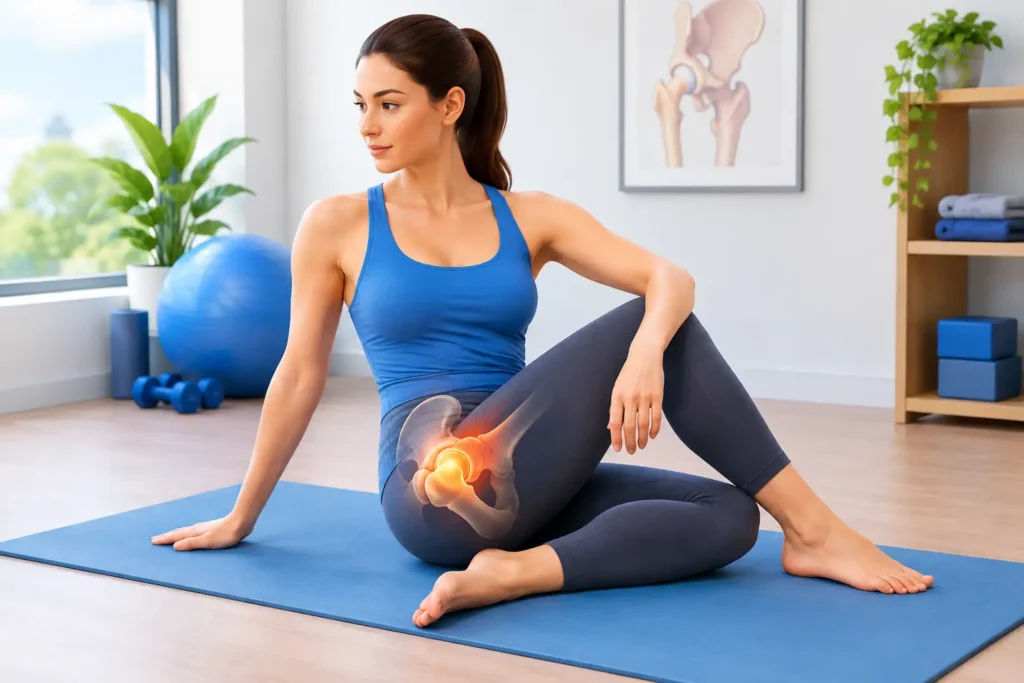
A deep squat that feels blocked, stiffness when getting out of the car, or a pinch at the front of the hip during a run are not problems to stretch through blindly. Knowing how to improve hip mobility starts with understanding what is limiting the movement and choosing exercises that help your body move with more control, not simply more range.
Your hips are designed to be strong, stable and mobile. They carry load when you walk, climb stairs, train, sit down and stand up. When movement becomes restricted, the cause may be tight or overworked muscles, prolonged sitting, a recent injury, reduced strength, joint irritation or an underlying condition such as osteoarthritis. The right approach depends on the reason your hip feels stiff.
Hip mobility is more than flexibility
Flexibility describes how far a muscle can lengthen. Mobility is the ability to actively move a joint through an available range with control. You may be able to pull your knee towards your chest using your hands, for example, but struggle to lift it comfortably when walking upstairs. That is a mobility and strength issue as much as a flexibility issue.
The hip is a ball-and-socket joint, so it needs to move in several directions: bending, extending behind you, rotating in and out, and moving away from or towards the midline. Good hip mobility also relies on the pelvis, lower back, gluteal muscles and abdominal muscles working together.
This is why a long static stretch is not always the answer. If the joint is irritated, forcing range can increase pain. If the main problem is poor control or weakness, stretching alone may create a temporary sensation of relief without changing how you move.
First, notice what your hip is telling you
A useful starting point is to identify when the restriction happens. Stiffness after a long day at a desk often responds well to regular movement breaks and gradual strengthening. A sharp pinch in the groin when you squat deeply, however, needs a more careful approach. Some people also feel discomfort on the outside of the hip, in the buttock or down the thigh. The location and behaviour of pain can help guide the best treatment plan.
Avoid repeatedly testing a painful movement to see whether it has improved. Instead, choose a comfortable starting range and build from there. Mild muscular effort or a gentle stretch can be appropriate; sharp pain, catching, locking, giving way or pain that worsens for hours afterwards is not.
If you have had a fall, cannot put weight through the leg, develop sudden severe pain, have a hot swollen joint, fever, unexplained weight loss, or new numbness and weakness, seek urgent medical advice. Persistent night pain or pain that is steadily worsening also warrants assessment.
How to improve hip mobility with controlled movement
For most people, the most effective routine combines gentle joint movement, targeted muscle work and strength training. Aim to practise little and often rather than trying to make up for a sedentary week with one intense stretching session. Ten minutes, four or five days a week, is a realistic place to start.
Start with a comfortable hip warm-up
Begin with five to ten minutes of easy walking, a gentle cycle or marching on the spot. Warm tissues usually tolerate movement better than cold ones. If sitting makes you stiff, even a short walk before your exercises can make the session feel noticeably easier.
Move slowly and breathe normally. Holding your breath or bracing aggressively can make the hips and lower back feel more guarded, particularly if pain has been present for some time.
Use these five hip mobility exercises
Choose three or four of the following exercises to begin with. Perform them on both sides where appropriate, staying within a range that feels manageable. You should finish feeling looser or more confident in the movement, not aggravated.
- 90/90 hip rotations: Sit on the floor with both knees bent and your feet wider than your hips. Let both knees drop slowly to one side, then return through the middle and move to the other side. Use your hands behind you for support. This introduces controlled hip rotation without loading the joint heavily.
- Adductor rock-backs: Start on hands and knees. Straighten one leg out to the side with the foot flat, then gently sit your hips back towards your heels before returning forwards. Keep your back relaxed and move only as far as is comfortable. This can help the inner thigh and hip feel less restricted.
- Half-kneeling hip flexor stretch: Kneel with one knee down and the other foot in front. Tuck your pelvis slightly, squeeze the glute on the kneeling side, and shift forwards a small amount. You should feel the stretch across the front of the hip rather than compression in the lower back. Hold for 20 to 30 seconds, then repeat.
- Glute bridges: Lie on your back with knees bent and feet hip-width apart. Press through your feet, gently lift your hips, pause, and lower with control. Gluteal strength helps the hips manage everyday load and supports the pelvis during walking and running.
- Supported squat holds: Hold a kitchen worktop, sturdy rail or door frame and lower into a shallow squat. Keep your feet planted and allow your knees to travel in the same direction as your toes. Pause where you feel a useful effort without pinching, then stand. Over time, gradually increase the depth only if it remains comfortable.
Two sets of six to ten slow repetitions is enough at first. With the hip flexor stretch, complete two or three comfortable holds per side. Consistency matters more than pushing for an impressive range on day one.
Build strength to keep the range you gain
Mobility that cannot be controlled is not always useful mobility. Once basic movements feel easier, include exercises that strengthen the glutes, thighs and trunk. Sit-to-stands from a chair, step-ups, split squats and resistance-band side steps are all useful options when matched to your current ability.
The right progression depends on your goal. A runner may need single-leg strength and pelvic control. Someone with arthritis may benefit more from gradually increasing tolerance for walking, stairs and getting up from a chair. If deep hip flexion causes a pinch, it may be sensible to work in a shallower range while improving strength, rather than insisting on deep squats immediately.
This is also where professional guidance can make a meaningful difference. A physiotherapist can assess whether your hip movement is genuinely restricted, whether the restriction is coming from the lower back or pelvis, and which exercises are most likely to improve your function.
Change the daily habits that keep hips stiff
Exercise is valuable, but it has to compete with how you spend the rest of the day. There is no single perfect posture, yet remaining in one position for hours is rarely helpful for sensitive hips.
If you work at a desk, stand and walk briefly every 30 to 60 minutes where possible. Take calls on your feet, use the stairs, or add a few hip rotations and sit-to-stands between tasks. When travelling, get up and move at regular intervals. These small exposures to movement are often more effective than one prolonged stretch at the end of the day.
Sleep position can matter too. If lying on your side causes outer-hip pain, try a pillow between the knees to reduce pressure and keep the pelvis more level. If symptoms began after a sudden increase in training, reduce the aggravating activity temporarily but avoid complete rest unless advised otherwise. Hips generally respond better to sensible, progressive loading than to prolonged inactivity.
When hip stiffness needs specialist assessment
Home exercises are appropriate for many mild, recent symptoms. They are less suitable when pain persists beyond a few weeks, repeatedly returns, limits work or sport, or has not improved despite consistent self-management. Groin pain, catching, marked loss of rotation, pain after a significant injury and symptoms that disturb sleep all deserve a thorough musculoskeletal assessment.
At FAB Clinic, specialist clinicians can combine hands-on assessment with fast, accurate diagnostic insight where appropriate. Diagnostic ultrasound may help assess certain soft-tissue structures around the hip, while a clear rehabilitation plan can address the movement, strength and load-management factors that keep symptoms going. Where clinically indicated, further treatment options can be discussed as part of an integrated plan focused on pain relief and restored function.
The most useful hip mobility routine is the one you can repeat comfortably and progress with confidence. Treat stiffness as information, not a challenge to overpower: move regularly, strengthen the range you have, and seek expert assessment when pain or restriction is stopping you from living as actively as you want.