
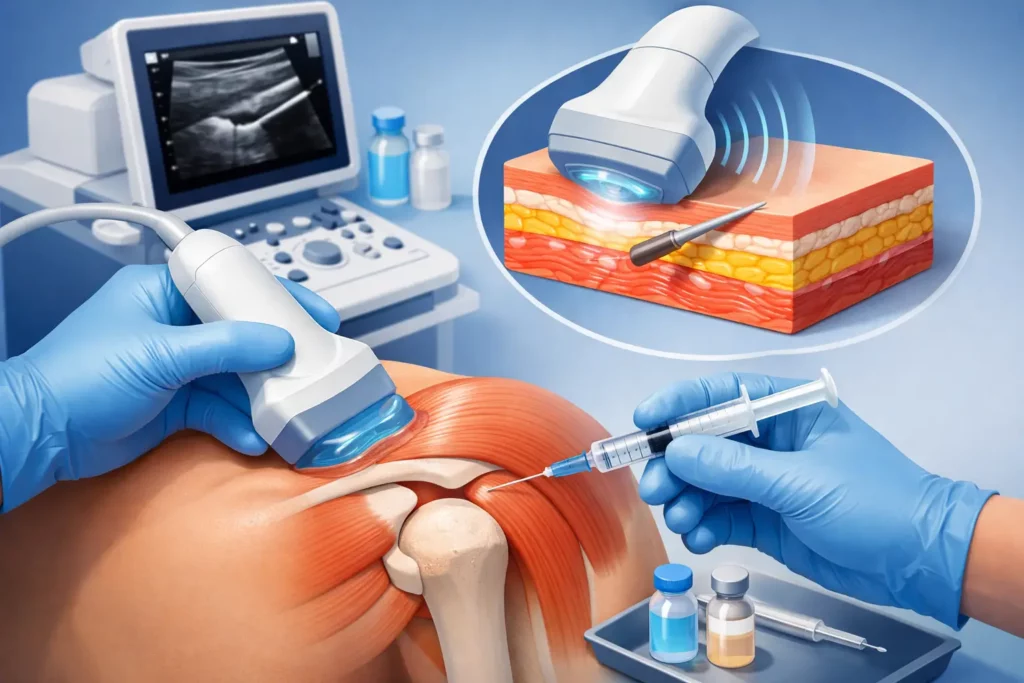
Pain that limits your sleep, work, sport or everyday movement deserves more than guesswork. This guide to ultrasound guided injections explains how real-time imaging can help clinicians target the source of musculoskeletal pain with greater accuracy, while placing injections within a wider plan for lasting recovery.
What are ultrasound guided injections?
An ultrasound guided injection uses a small handheld scanner to create live images of muscles, tendons, ligaments, joints, bursae and surrounding soft tissues. The clinician uses these images to identify the area being treated and guide the needle into the intended position.
Unlike an injection delivered using surface landmarks alone, ultrasound allows the practitioner to see important structures as they work. This can be particularly helpful when treating smaller joints, deeper tissues or areas close to nerves and blood vessels.
The injected medicine depends on the diagnosis and treatment goal. It may include a local anaesthetic to help confirm the pain source or offer short-term relief, corticosteroid to reduce inflammation, or another clinically appropriate injectable treatment. The right option is never decided by the scan alone. Your symptoms, examination findings, medical history and recovery goals all matter.
Why precision matters
Musculoskeletal pain is not always straightforward. A painful shoulder may involve a bursa, tendon, joint or more than one structure. Heel pain can stem from the plantar fascia, while pain around the hip may be linked to a tendon or bursa. Treating the wrong structure is unlikely to deliver the outcome you want.
Ultrasound provides fast, accurate insight into many soft-tissue and joint problems. During an assessment, it can help a specialist identify inflammation, fluid, tendon changes and other features that may influence the best treatment plan. When an injection is suitable, imaging helps direct the needle towards the selected target and away from structures that should be avoided.
That does not mean every injection requires ultrasound, or that imaging guarantees pain relief. Some conditions respond better to rehabilitation, activity modification, shockwave therapy or another approach. Injections are a tool, not a cure-all. Their value lies in using them at the right time, for the right diagnosis and alongside the right recovery plan.
Conditions that may be treated with ultrasound guidance
Ultrasound guided injections are commonly considered for pain and inflammation affecting joints and soft tissues. This may include shoulder bursitis, frozen shoulder, rotator cuff-related pain, tennis or golfer’s elbow, wrist or thumb joint pain, hip bursitis, knee arthritis, Baker’s cysts, plantar fasciitis and selected tendon conditions.
They can also be useful where a patient has made limited progress with initial conservative treatment, such as physiotherapy and tailored exercise, or when pain is preventing meaningful rehabilitation. For example, reducing severe inflammation around a shoulder may make it possible to begin movement work that was previously too painful.
Suitability varies considerably. A tendon injection, for instance, needs careful clinical judgement because steroid is not appropriate for every tendon problem. Persistent pain may also be referred from the spine or linked to a condition that an injection will not address. A thorough assessment protects patients from pursuing a treatment that does not match the underlying issue.
Your ultrasound guided injection appointment
At a specialist clinic, the appointment should begin with a focused clinical discussion rather than an immediate procedure. Your practitioner will ask about the history of your symptoms, what aggravates or eases them, treatments you have already tried, medication, allergies and relevant health conditions. They will also assess movement, strength and the painful area itself.
If diagnostic ultrasound is appropriate, the scan is performed with gel on the skin. It is generally comfortable and does not use radiation. The clinician will explain what they can see, how it relates to your symptoms and whether an injection is likely to be useful.
If you choose to proceed, the skin is cleaned carefully and sterile equipment is used. The ultrasound probe is covered appropriately, and the clinician watches the needle on the screen as it approaches the treatment area. You may feel a brief scratch or pressure. Some injections cause a temporary ache or fullness as the medication is introduced, but the procedure itself is usually quick.
Afterwards, you will be given clear advice based on the body part treated, the medicine used and your normal activities. FAB Clinic combines imaging-led assessment with physiotherapy and rehabilitation, so treatment can be connected to the practical work of restoring strength, confidence and mobility.
What happens after the injection?
A local anaesthetic, if used, may provide relief within minutes or hours. This effect is temporary and can make the area feel deceptively comfortable, so it is sensible not to test it with a hard gym session, long run or heavy lifting that same day.
Steroid injections generally take longer to have an effect. Some people notice improvement within a few days, while for others it can take one to two weeks. A short-lived increase in pain after an injection can occur, often called a post-injection flare. Resting relatively, using simple pain relief if medically suitable, and following the advice you have been given can help.
You may be advised to avoid strenuous activity for a short period, but complete inactivity is rarely the aim. The next step is usually a progressive return to movement. This may involve mobility exercises, gradual loading, changes to training volume, hands-on treatment or a structured rehabilitation programme. The plan should reflect your life, whether that means returning to a desk-based role comfortably, walking without a limp or getting back to your sport.
Benefits, limitations and risks
The potential benefits are clear: a more accurately targeted procedure, relief of pain or inflammation, and a window in which you can move and rehabilitate more effectively. For some patients, this can accelerate progress after weeks or months of restricted function.
However, results vary. An injection may reduce symptoms without resolving the factors that caused them, such as overload, poor movement control, joint stiffness or an unsuitable training programme. Relief can be temporary, and repeat injections are not always advisable. The safest frequency depends on the tissue involved, the medication used and your wider health picture.
All injections carry some risk, although serious complications are uncommon when carried out by a properly qualified clinician using appropriate sterile technique. Possible effects include temporary pain, bruising, skin colour changes, infection, bleeding, allergic reaction and, with some steroid injections, a temporary rise in blood sugar. There are also tissue-specific considerations, including potential tendon weakening in certain situations.
Tell your clinician if you take anticoagulants, have diabetes, are pregnant, have an active infection, feel unwell, have had a recent vaccination or have reacted to an injection before. Do not stop prescribed medication unless the clinician managing it tells you to do so.
Seek urgent medical advice after an injection if you develop worsening redness, heat and swelling around the site, fever, severe or escalating pain, feeling generally unwell, or symptoms of an allergic reaction. You should receive specific contact and aftercare instructions before leaving the clinic.
Questions to ask before treatment
Is an injection the best next step for me?
Ask what the assessment suggests is causing your pain, what alternatives are available and what outcome is realistic. The best answer may be an injection, a rehabilitation-led plan or further investigation. Good care is decisive without being rushed.
What exactly is being injected?
Your clinician should explain the medication, why it has been recommended, its expected timescale and the relevant risks. This helps you give informed consent and plan sensible activity afterwards.
How will this fit into my recovery plan?
An injection should not be a standalone event. Ask when to restart exercises, what activities to avoid temporarily and how progress will be reviewed. This is where treatment becomes a route back to function rather than a short pause in symptoms.
The most useful injection is one that gives you a clearer path forward: less pain where possible, better movement where it matters, and expert support to keep you moving with confidence.