
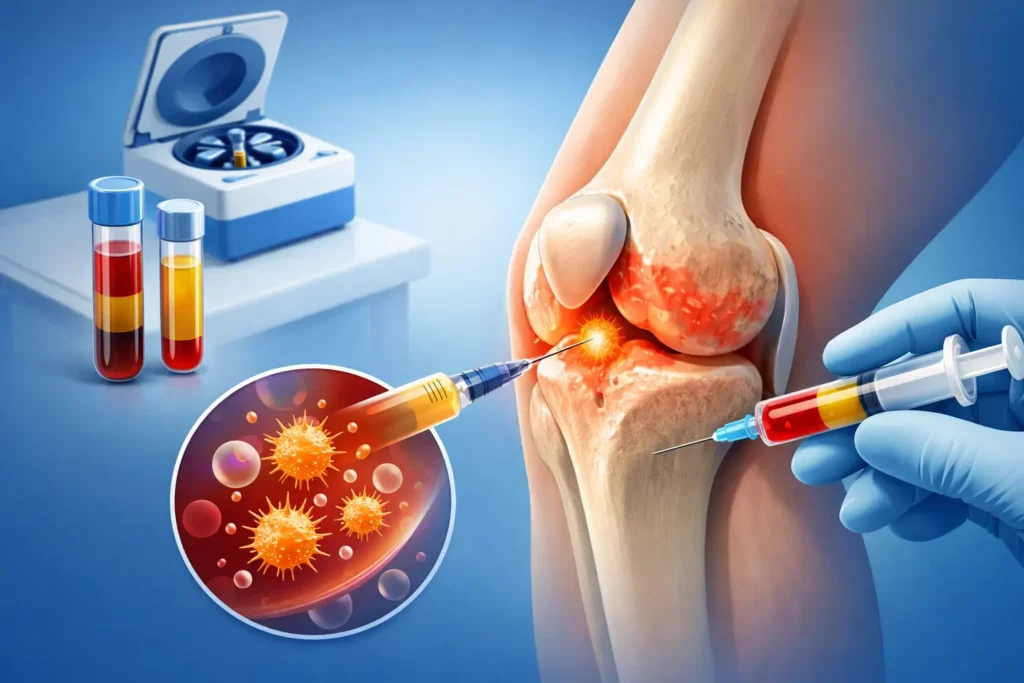
A knee that aches on stairs, stiffens after sitting or swells after a longer walk can steadily shrink the things you feel able to do. For many people, painkillers and a basic exercise programme do not provide enough relief. PRP injections for knee arthritis are increasingly considered when symptoms are limiting mobility, but they are not a cure-all and they work best as part of a carefully planned treatment pathway.
What PRP is and why it may help an arthritic knee
PRP stands for platelet-rich plasma. It is made from a small sample of your own blood. The sample is processed to concentrate platelets and plasma, then the prepared PRP is injected into the knee joint.
Platelets are best known for helping blood to clot, but they also contain signalling proteins involved in the body’s repair and inflammatory responses. In an osteoarthritic knee, the aim is not to regrow a severely worn joint overnight. Rather, PRP may help to calm the inflammatory environment inside the joint and improve pain and function for some patients.
Knee arthritis is more complex than “wear and tear”. Changes in cartilage, bone, the joint lining, surrounding muscles and how the nervous system processes pain can all contribute to symptoms. That is why the same scan result can feel very different from one person to another. A treatment plan needs to consider your pain, movement, strength, activity demands and the stage of arthritis, not imaging alone.
Do PRP injections for knee arthritis work?
Research suggests that PRP can improve knee pain and day-to-day function for some people with mild to moderate knee osteoarthritis. In comparative studies, it has often shown more sustained benefit than hyaluronic acid injections or placebo for selected patients. However, results are variable, and the quality of PRP preparations and treatment protocols differs between studies.
This variation matters. PRP is not one identical product. The concentration of platelets, the presence of white blood cells, the amount injected and whether one or several injections are used may all influence the response. For this reason, promises of guaranteed cartilage regeneration or permanent pain relief should be treated cautiously.
The most realistic expectation is a reduction in pain and improved confidence with walking, stairs, exercise or work activities. Some people notice a meaningful improvement over several weeks and may continue to benefit for months. Others experience modest relief, short-lived benefit or no worthwhile change. PRP does not reverse advanced joint damage, correct a major mechanical problem or replace the need for knee surgery where surgery is clearly indicated.
Who may be a good candidate?
PRP is commonly considered for people whose knee arthritis remains troublesome despite sensible first-line care, such as activity modification, targeted strengthening, weight management where appropriate and simple pain relief. It may be particularly relevant when symptoms are affecting work, exercise, sleep or independence, and you want to explore a minimally invasive option before considering more invasive treatment.
People with mild to moderate osteoarthritis often have more potential to benefit than those with severe bone-on-bone arthritis, substantial deformity or a knee that is persistently very swollen. That does not mean advanced arthritis automatically rules PRP out. It means the likely benefit, alternatives and value of treatment should be discussed honestly.
A thorough assessment is essential. Knee pain can arise from a meniscal injury, tendon problem, referred pain from the hip or back, inflammatory arthritis, gout or another condition that needs a different approach. Fast, accurate diagnostic insight helps ensure an injection is being offered for the right reason.
PRP may not be suitable if you have an active infection, certain blood or platelet disorders, uncontrolled medical conditions, or are taking medication that affects clotting. Your clinician will review your medical history and current medicines before proceeding. Never stop prescribed medication without medical advice.
What happens during treatment?
The procedure usually begins with a clinical assessment of your knee, your symptoms and the treatments you have already tried. At FAB Clinic, this can include specialist musculoskeletal assessment and diagnostic ultrasound where appropriate, allowing the team to build the best treatment plan around the source of your pain and your recovery goals.
On the day, a small amount of blood is taken from your arm and placed in a centrifuge. This separates the blood components so the PRP can be prepared. The injection itself is generally quick. Ultrasound guidance can be used to visualise the joint and guide the needle accurately into the intended area.
Most patients tolerate the procedure well. You may feel a brief sharp sensation from the needle and pressure as the injection is given. Because PRP is derived from your own blood, the risk of an allergic reaction is low. As with any injection, there remains a small risk of infection, bleeding, bruising, pain flare and, rarely, injury to nearby structures.
It is common for the knee to feel sore or more irritable for a few days afterwards. This does not necessarily mean the treatment has failed. Your clinician will advise on appropriate activity, pain relief and whether anti-inflammatory medication should be avoided around the procedure. Advice varies according to your medical history and the treatment protocol, so follow the guidance you are given rather than relying on generic online recommendations.
Rehabilitation is what turns pain relief into progress
An injection can create an opportunity to move more comfortably. Rehabilitation helps you make use of that opportunity. If the muscles around the hip and knee remain weak, the joint is stiff, or you return too quickly to high-impact activity, the same limitations can soon reappear.
A progressive programme normally focuses on quadriceps strength, hip control, balance, knee range of movement and gradual return to the activities that matter to you. For one person, that may mean getting through a commute without planning every staircase. For another, it may mean returning to tennis, gardening or playing with grandchildren.
The pace should be individual. Complete rest for weeks is rarely the answer, but neither is pushing through escalating pain. A physiotherapist can help you find the right loading level, adjust exercises when the knee is reactive and build capacity without unnecessary setbacks. If weight is contributing to joint load, supportive and realistic lifestyle guidance can also improve symptoms without turning recovery into an all-or-nothing project.
PRP compared with other knee arthritis treatments
PRP sits alongside, rather than above, other treatment options. The right choice depends on the diagnosis, severity of symptoms, medical history, priorities and budget.
Corticosteroid injections can provide short-term relief when inflammation and swelling are prominent, although repeated use needs careful consideration. Hyaluronic acid injections aim to improve joint lubrication and may help some people, but responses also vary. Physiotherapy remains central because stronger, better-controlled movement can reduce pain and improve function regardless of whether an injection is used.
For persistent severe arthritis, an orthopaedic opinion may be appropriate, particularly where pain is significantly affecting quality of life and non-surgical care is no longer giving enough benefit. Choosing surgery is not a failure, just as choosing an injection is not a shortcut. Good care is about selecting the option that makes sense for your knee and your life.
Questions worth asking before you decide
Before having PRP, ask what is believed to be causing your pain, what outcome is realistic in your case and how success will be measured. You should also understand how the PRP is prepared, whether the injection will be image-guided, what aftercare is included and what rehabilitation plan will follow.
It is equally reasonable to ask what happens if it does not help. A clinician should be able to explain the next step, whether that is a revised rehabilitation programme, another injection option, further investigation or an orthopaedic referral. Decisive treatment is valuable, but it should never mean skipping the assessment that makes treatment precise.
The best time to consider PRP is when it forms part of a clear plan: establish the cause of your knee pain, set practical goals, use the injection only where it is likely to add value, and follow it with progressive rehabilitation. That approach gives your knee the strongest chance of moving more freely again.