
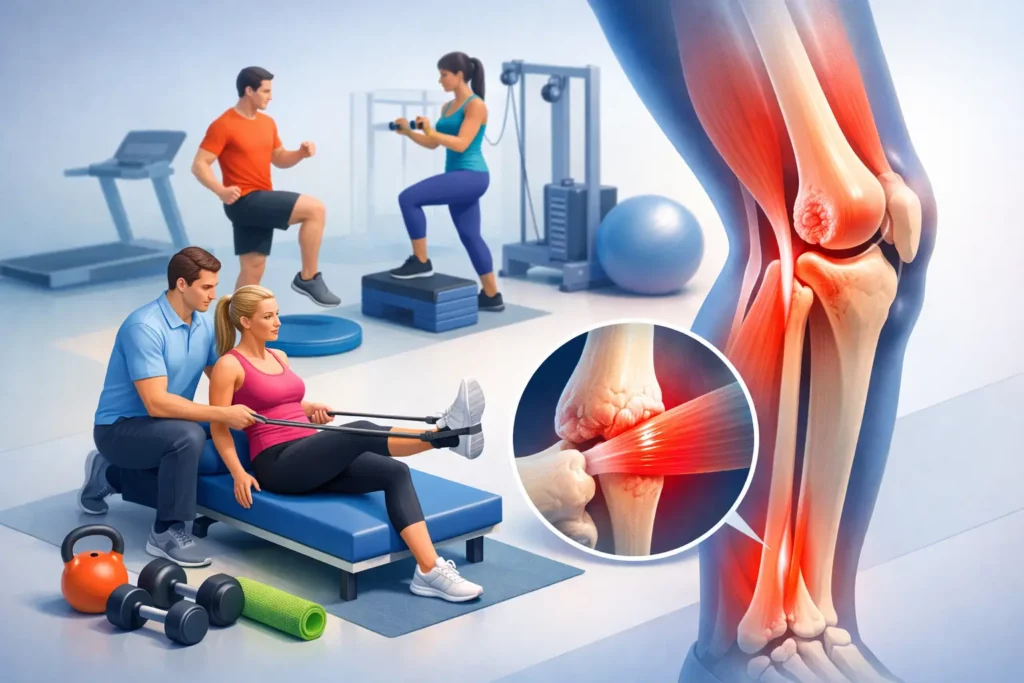
That sharp pull in your Achilles when you get out of bed, the stubborn ache at the outside of the elbow after a day at your desk, the shoulder pain that flares every time you reach overhead – tendon problems rarely settle well with rest alone. Exercise rehabilitation for tendon recovery is usually the part that changes the long-term picture, because tendons respond best to the right load, introduced at the right stage, for the right reason.
This is where many people get stuck. They are told to stop aggravating the area, wait for the pain to calm down, and then hope normal activity will return on its own. In practice, tendon recovery is rarely that simple. A tendon often needs structured loading to regain tolerance, strength and function, especially if symptoms have been present for weeks or months.
Why exercise rehabilitation for tendon recovery matters
A tendon is the structure that connects muscle to bone. It transfers force, stores energy and helps the body move efficiently. When a tendon becomes irritated or overloaded, pain is only one part of the problem. The tissue’s ability to cope with load can drop, and everyday tasks that were once straightforward can become difficult.
This is why complete rest is often a poor long-term strategy. It may reduce symptoms for a short while, but it does not prepare the tendon for walking, lifting, climbing stairs, running or sport. Once normal activity resumes, the same tissue is asked to do the same job without having rebuilt its capacity.
Well-planned rehabilitation addresses that gap. It gives the tendon a reason to adapt. That might mean starting with pain-calming isometric work, then progressing to heavier slow resistance, then to more dynamic drills when the tendon is ready. The exact route depends on the tendon involved, symptom severity and what you need your body to do.
Tendon recovery is about load management, not just exercise choice
Patients often ask which exercise is best for a sore tendon. The better question is how much load the tendon can handle today, and what it needs next. The same calf raise can be helpful, ineffective or aggravating depending on volume, speed, range, frequency and timing.
A good plan looks beyond a single exercise. It considers your total load across the week – commuting, training, standing at work, childcare, poor sleep, recent changes in activity and previous injury. These factors influence recovery more than many people realise. If the tendon is repeatedly pushed above its current capacity, progress can stall even when the exercises themselves are appropriate.
This is why assessment matters. Persistent tendon pain can mimic other conditions, and some cases need a closer look to identify whether there is tendon thickening, partial tearing, bursitis, joint involvement or a different source of pain altogether. Fast, accurate insight leads to a better treatment plan.
What exercise rehabilitation for tendon recovery usually involves
Early rehabilitation is often about settling pain while keeping the tendon engaged. Isometric exercises can be useful here. These are static holds where the muscle works without visible movement at the joint. They do not suit every patient, but in some cases they can reduce pain and restore confidence with loading.
Once symptoms are more settled, the focus usually shifts to strength work. Heavy slow resistance is commonly used because it improves the tendon and muscle’s ability to manage force. The key word is gradual. Tendons tend to respond better to consistent progression than to sudden jumps in intensity.
After that, rehabilitation often becomes more specific. A runner with Achilles tendon pain may need controlled plyometric drills and return-to-running progressions. Someone with gluteal tendinopathy may need pelvic control work and changes to aggravating positions. A person with tennis elbow may need forearm loading, grip training and adjustments to repetitive tasks at work.
The programme should match the tendon and the person, not just the diagnosis.
Pain during rehab – how much is acceptable?
This is one of the most common concerns, and the answer is not always black and white. Mild pain during tendon rehab is often acceptable, particularly in longstanding cases, provided symptoms settle and do not progressively worsen. Chasing completely pain-free loading can leave the tendon undertrained. On the other hand, pushing hard through severe pain usually backfires.
What matters is response. If pain is significantly worse the next morning, if stiffness is increasing, or if function is declining, the programme may need adjusting. Small changes in volume, tempo or exercise selection can make a meaningful difference.
Common mistakes that slow tendon recovery
The first is doing too little for too long. This often happens after a painful flare-up. People avoid movement for weeks, then return to full activity as soon as it feels slightly better. The tendon has had no structured rebuild, so symptoms return.
The second is doing too much too soon. A strong exercise programme is not the same as a rushed one. Tendons adapt slowly, and they do not respond well to dramatic spikes in load.
The third is copying a generic plan from the internet. Some tendon protocols are useful, but not every sore heel is the same Achilles problem and not every painful shoulder is driven by the rotator cuff tendon alone. If symptoms are persistent, recurrent or limiting your mobility, a tailored approach is more effective.
The fourth is focusing only on the painful area. The tendon matters, but so do strength deficits elsewhere, movement patterns, footwear, training errors and recovery capacity. Looking at the whole chain often explains why the tendon has been overloaded in the first place.
When a tendon needs more than exercise alone
Exercise is central to recovery, but it is not the only tool. Some patients benefit from hands-on treatment to ease surrounding muscle tension and improve movement tolerance while rehabilitation builds. Others need imaging-led assessment to confirm what is happening in the tissue and rule out other drivers of pain.
In more stubborn cases, additional treatments may be considered alongside exercise rehabilitation for tendon recovery. Depending on the presentation, this can include extracorporeal shockwave therapy, ultrasound-guided diagnostics, or injection-based treatment where clinically appropriate. These options are not shortcuts, and they do not replace rehabilitation, but they can support progress when symptoms are persistent and standard care has not resolved the problem.
At a specialist clinic such as FAB Clinic, this integrated model can be particularly valuable. It allows patients to move from assessment to targeted treatment and rehabilitation planning without the delays that often slow recovery.
How long does tendon rehabilitation take?
This depends on the tendon, the duration of symptoms and the demands you want to return to. A mild reactive tendon problem caught early may improve in a matter of weeks. A longstanding tendinopathy that has been flaring for months may need several months of progressive loading before the tendon becomes reliably tolerant again.
There is no honest one-size-fits-all timeline. Age, general health, strength levels, body weight, medication history and previous injury can all influence recovery. So can the demands of your routine. Someone trying to recover while continuing a physically demanding job may need a different strategy from someone who can temporarily reduce load.
What matters most is steady direction of travel. Better morning stiffness, improved confidence with stairs, increased tolerance to walking or gym work, and fewer flare-ups are all signs the tendon is moving the right way.
When to seek specialist help for tendon pain
If tendon pain has lasted more than a few weeks, keeps returning, or is stopping you from training, working or sleeping comfortably, it is worth having it properly assessed. The same applies if the pain came on suddenly with a snap, noticeable weakness or significant swelling, as this may need urgent evaluation.
Specialist assessment is also useful when previous physiotherapy has not helped, when you are unsure how much to load the area, or when you want a clearer diagnosis before committing to a rehab plan. Advanced musculoskeletal care can shorten the guesswork. Accurate diagnosis, measured progression and the right treatment pathway usually lead to better outcomes than repeated trial and error.
Tendon recovery rarely improves through rest, frustration and hope. It improves when the tendon is given a clear, progressive reason to get stronger again – and when your plan reflects both the tissue in front of you and the life you need to get back to.