
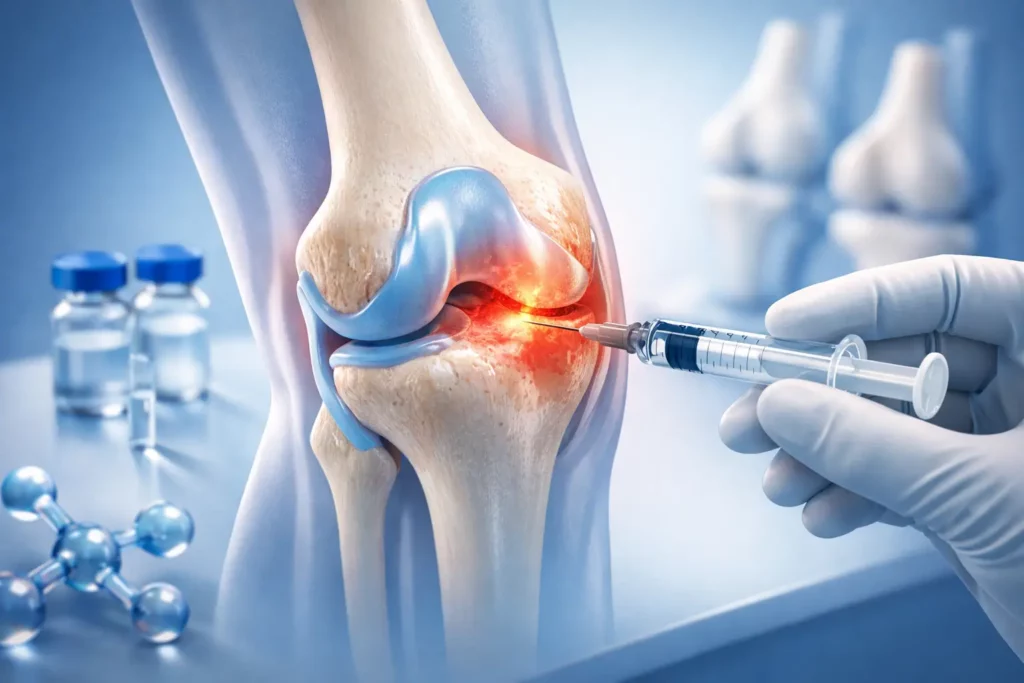
When knee pain starts dictating how far you can walk, whether you use the stairs, or how confident you feel getting up from a chair, treatment needs to be practical, not vague. Knee Ostenil injections are often considered when arthritis-related pain is no longer settling with exercise, activity modification, or simple pain relief, but surgery is not the next step you want.
For many people, the real question is not just whether an injection can help. It is whether it can help enough to improve movement, settle irritation in the joint, and give you a proper window to rebuild strength. That is where a clear diagnosis and the right treatment plan matter.
What are knee Ostenil injections?
Ostenil is a hyaluronic acid injection used for joints affected by osteoarthritis. Hyaluronic acid is a substance found naturally in healthy joint fluid, where it helps with lubrication and shock absorption. In an arthritic knee, that joint environment can become less efficient, which contributes to stiffness, pain, and reduced movement.
Knee Ostenil injections aim to improve the quality of the joint’s lubrication. They are not a cure for arthritis, and they do not reverse cartilage wear. What they may do is reduce pain and help the joint move more comfortably, particularly in people whose symptoms are linked to mild to moderate osteoarthritis.
This treatment is often described as viscosupplementation. The principle is straightforward – if the natural joint fluid is no longer doing its job well, adding a hyaluronic acid product may improve how the knee functions for a period of time.
When are knee Ostenil injections worth considering?
These injections are usually considered when knee arthritis is affecting daily life and more conservative care has not been enough on its own. That might mean pain during walking, stiffness after sitting, swelling after activity, or difficulty with kneeling, bending, or managing longer days on your feet.
They can be a sensible option for people who are not ready for surgery, want to delay surgery, or need a treatment that sits between rehabilitation and more invasive intervention. They may also be useful for active adults who want to stay mobile, older patients trying to remain independent, and working professionals who need better day-to-day function rather than simply masking symptoms.
That said, suitability depends on the knee itself. If pain is coming mainly from another structure, such as a meniscal issue, referred pain from the hip, or significant inflammatory flare-up, the best next step may be different. This is why assessment matters far more than choosing an injection by name.
How the injection works in the knee joint
In osteoarthritis, the knee joint does not just become worn. The whole environment of the joint changes. Cartilage can thin, the lining of the joint may become irritated, and the fluid inside the joint may lose some of its normal cushioning and lubricating qualities.
Ostenil is injected directly into the knee joint to support that fluid environment. For some patients, this can lead to less friction-related discomfort, easier movement, and a reduction in the cycle of pain and guarding. The effect is not usually instant in the way a local anaesthetic would be. Improvement often builds over days or a few weeks.
Results vary. Some patients notice meaningful relief for several months, while others get a more modest change. The degree of arthritis, joint inflammation, overall strength, body mechanics, and activity levels all influence the outcome.
Who is most likely to benefit?
The best candidates are often people with confirmed knee osteoarthritis who still have a reasonable amount of joint space and whose pain pattern fits mechanical arthritis symptoms. That usually means pain with weight-bearing, stiffness after rest, and reduced confidence with daily movement.
Patients with mild to moderate arthritis often respond better than those with very advanced joint degeneration, although that is not an absolute rule. If the knee is severely worn, significantly deformed, or persistently inflamed, another injection type or a different treatment pathway may be more appropriate.
An ultrasound-guided or clinically guided assessment can help identify whether the pain is truly coming from the joint and whether there is swelling, synovial irritation, or another contributing issue that needs addressing. In specialist musculoskeletal care, injections work best when they are part of a broader plan rather than a standalone fix.
What happens during the procedure?
The procedure itself is usually quick. After confirming the indication for treatment and ruling out reasons not to proceed, the skin is cleaned and the injection is placed into the knee joint. In some cases, imaging guidance is used to improve accuracy, particularly where anatomy is less straightforward or where precise placement is important.
Most patients tolerate the procedure well. You may feel pressure or brief discomfort, but it is generally manageable. After the injection, it is common to be advised to take it easy for a short period, usually for the rest of the day and sometimes for 24 to 48 hours depending on your clinician’s advice and your symptoms.
A small flare in discomfort can happen temporarily after the injection. That does not necessarily mean the treatment has failed. It is usually short-lived, but if pain becomes severe or the knee becomes very swollen, hot, or difficult to bear weight on, medical review is important.
How long does it take to work?
This is one of the most common questions, and the honest answer is that it depends. Some patients feel a difference within days. Others notice the knee gradually settling over two to six weeks.
Unlike steroid injections, which are often used to calm inflammation more rapidly, hyaluronic acid treatments are usually judged over a slightly longer window. The goal is often smoother joint movement and more sustainable improvement in comfort rather than a dramatic immediate change.
If the injection helps, the benefit may last for several months. For some people, that window is long enough to improve walking tolerance, restart strengthening work, and reduce reliance on pain medication. For others, the benefit is present but limited. Setting realistic expectations from the start is part of good care.
Knee Ostenil injections versus steroid injections
Patients often ask which is better. There is no universal answer because the right option depends on the pattern of symptoms.
Steroid injections are generally used when inflammation is a more dominant feature, especially if the knee is acutely irritable, swollen, and painful. They can provide faster relief, but the effect may be shorter-lived in some cases.
Knee Ostenil injections are more often considered where osteoarthritis symptoms are ongoing, mechanical, and linked to joint wear and reduced lubrication rather than a major inflammatory flare. They may suit patients looking for an alternative to repeated steroid use or those who want to support function over time.
In some treatment pathways, one option is clearly preferable. In others, the decision comes down to examination findings, scan results, previous response to treatment, and your wider recovery goals.
Why rehab still matters after the injection
An injection can reduce pain, but it does not rebuild a weak quadriceps, improve hip control, or correct the movement patterns that have been overloading the knee. This is where many patients get disappointed – not because the injection was wrong, but because the next phase was missed.
If your pain eases, that is the moment to use the opportunity well. Targeted rehabilitation can improve muscle support around the knee, restore confidence with movement, and make day-to-day activities easier. Weight management, activity pacing, strength work, and mobility exercises still matter, even when an injection is clinically appropriate.
This integrated approach is often where patients get the best results. At FAB Clinic, that means combining accurate musculoskeletal assessment with hands-on treatment, guided rehabilitation, and injection therapy where it genuinely fits the bigger picture.
Are there any risks or reasons not to have it?
As with any joint injection, there are potential risks, although serious complications are uncommon. These can include temporary pain after the procedure, swelling, bruising, and in rare cases infection or an inflammatory reaction.
Not everyone is suitable. If you have an active infection, certain skin issues around the injection site, or if the diagnosis is uncertain, the injection may need to be delayed or avoided. It is also worth discussing allergies, previous reactions to injections, and any relevant medical conditions before treatment.
The more important point is that a knee injection should never be used to cover up an unclear diagnosis. If the pain source has not been properly identified, even a technically well-delivered injection may miss the mark.
What sort of results should you realistically expect?
The strongest outcomes tend to come when the right patient receives the right injection at the right stage of their condition. If your knee arthritis is mild to moderate, your symptoms are genuinely coming from the joint, and you are ready to follow through with rehabilitation, the injection may reduce pain enough to let you move better and recover more effectively.
If you are expecting the knee to feel completely normal again, that may not be realistic. Arthritis management is usually about reducing pain, improving function, and helping you stay active for longer. Even a moderate improvement can be valuable if it helps you walk more comfortably, sleep better, or get back to exercise without constant flare-ups.
The best next step is not guessing whether an injection is right for you. It is getting a precise assessment of why your knee hurts, how advanced the arthritis is, and which treatment plan gives you the best chance of lasting progress. When the diagnosis is accurate and the plan is built around recovery, not just symptom control, you give your knee the best chance to keep you moving.