
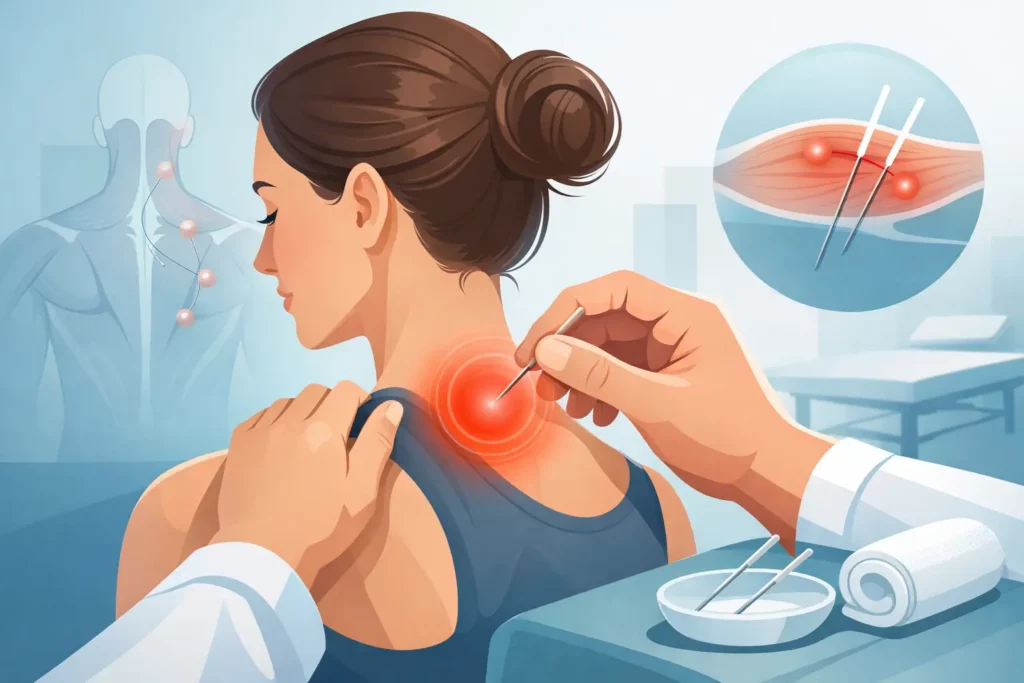
That tight band in your shoulder that will not release, the calf that keeps gripping after a run, or the knot between your shoulder blades that flares up at your desk often has a simple label – a muscle knot. For many patients, dry needling for muscle knots is one of the most effective ways to settle that pain quickly and restore more normal movement.
The key is using it for the right problem, in the right tissue, and as part of a clear treatment plan. A sore, tense area is not always just a knot, and when pain keeps returning there is usually a reason behind it. That is where expert assessment matters.
What are muscle knots, really?
Muscle knots are commonly used to describe myofascial trigger points. These are sensitive, irritable spots within a muscle or its surrounding fascia that can feel tight, tender or unusually reactive to pressure. Sometimes they cause local discomfort. Sometimes they refer pain elsewhere, which is why a trigger point in the shoulder can create pain down the arm or into the neck.
They often develop when a muscle is overloaded, held in one position for too long, compensating for weakness elsewhere, or recovering poorly after sport, injury or stress. Office-based workers can develop them from prolonged sitting and poor workstation setup. Active adults may notice them after repetitive training, sudden changes in load or incomplete recovery. Older adults may develop them around stiff joints or longstanding movement restrictions.
Not every painful area is a trigger point. Joint irritation, tendon pain, nerve sensitivity and referred pain from the spine can feel similar. If symptoms are severe, recurrent or not responding to standard treatment, a more detailed musculoskeletal assessment is the best place to start.
How dry needling for muscle knots works
Dry needling uses a very fine sterile needle inserted into the affected muscle to target a trigger point directly. The aim is to reduce muscle tension, calm pain, improve local blood flow and help the tissue return to more normal function.
When the needle reaches the trigger point, the muscle may produce a brief twitch response. Patients often describe this as a quick grab or cramp-like sensation. It can feel odd, but it is usually very short-lived and is often a sign the right area has been reached.
After treatment, the muscle frequently feels less guarded and movement becomes easier. For some people, the change is immediate. For others, it takes a day or two as post-treatment soreness settles and the muscle relaxes.
Dry needling is not the same as acupuncture, although both use fine needles. Acupuncture is based on traditional Chinese medicine principles, while dry needling is grounded in Western musculoskeletal assessment and targets specific muscles and trigger points linked to pain and dysfunction.
When dry needling is most useful
Dry needling for muscle knots can be particularly helpful when pain is being driven by a stubborn, localised area of muscle tension that has not eased with stretching, massage or rest alone. It is commonly used for neck pain, shoulder tension, upper back discomfort, gluteal tightness, calf tightness and sports-related muscle overload.
It can also be valuable when a muscle knot is limiting rehabilitation. For example, if a tight quadriceps muscle is stopping you from regaining knee movement, or a painful trigger point in the glute is affecting walking mechanics, dry needling may help create a window where better movement is possible.
That said, it is not a magic fix. If the reason for the knot remains unchanged – poor loading, weak supporting muscles, reduced joint mobility, training errors or persistent stress – the symptoms can return. The best results usually come when dry needling is paired with hands-on therapy, movement correction and a tailored exercise programme.
What treatment feels like
Most patients want to know one thing first – does it hurt?
The honest answer is that it can be uncomfortable, but it is usually very manageable. The needle itself is very fine, so the first sensation is often minimal. The more noticeable part is when the trigger point responds. That may produce a twitch, a deep ache or a brief cramp-like feeling. This tends to pass quickly.
Afterwards, the treated area may feel heavy, bruised or sore for 24 to 48 hours. This is common and usually settles without issue. Many patients then notice reduced tension, less pain and easier movement once that short-term soreness fades.
A qualified clinician will explain what they are treating, why they are using dry needling, and what response to expect. Good technique matters, but so does patient confidence and clear communication.
Who is a good candidate for dry needling for muscle knots?
Adults with muscular pain, restricted movement and clear trigger points often respond well, especially when symptoms are linked to work posture, gym training, sport, overuse or recovery from injury. It can suit people who feel they have tried stretching repeatedly without lasting improvement.
It may also help patients with persistent pain patterns where muscles have become protective and overactive around a joint problem. In these cases, the needle is not fixing the joint itself, but it may reduce secondary muscle guarding so rehabilitation becomes more effective.
However, it is not suitable for everyone. Some patients are needle-phobic, some have medical reasons to avoid it, and some do not actually have a trigger point problem in the first place. Pregnancy, certain bleeding risks, active infection and specific health conditions may change whether treatment is advised. That is why proper screening is essential.
Why assessment matters before treatment
A muscle knot is often the visible part of a bigger problem. A painful upper trapezius may be reacting to a stiff thoracic spine. Recurrent calf tightness may relate to ankle mobility, tendon loading or running mechanics. Gluteal trigger points may develop because the lower back or hip is not moving well.
If you only treat the knot, you may get short-term relief without a lasting change. A specialist musculoskeletal assessment helps identify whether the knot is the main pain source, a compensation pattern or a symptom of something else. This is especially important if pain keeps returning, symptoms are spreading, or previous treatment has only helped briefly.
In a clinic setting where physiotherapy, rehabilitation and more advanced diagnostics sit under one roof, treatment planning can be more precise. If the clinical picture suggests a tendon, joint or referred pain issue rather than a straightforward trigger point, the next step can be adjusted quickly rather than persisting with the wrong approach.
Dry needling versus massage and stretching
Patients often ask whether dry needling is better than massage. The better question is which tool best matches the problem.
Massage can be excellent for reducing general muscle tension, improving circulation and helping patients feel looser. Stretching can help maintain length and restore confidence in movement. Dry needling is more targeted. It aims to reach an irritable point within the muscle that may not fully release with manual pressure alone.
In practice, these treatments often work well together. A clinician may use dry needling to reduce a particularly stubborn trigger point, then follow with soft tissue work, mobility treatment and exercises to reinforce the change. If you are relying on any single treatment in isolation, results are often less durable.
How many sessions do you need?
This depends on how long the issue has been present, how many muscles are involved, whether there is an underlying joint or tendon problem, and how your body responds after the first session. Some patients feel a clear change after one treatment. Others need a short course.
Acute muscle knots after overuse or sport may settle quickly. Longstanding neck and shoulder tension linked to months of posture strain, stress and weak postural support usually takes more work. What matters is not chasing repeated needling for its own sake, but using it strategically while building a stronger recovery plan.
At FAB Clinic, that usually means looking beyond short-term pain relief and focusing on the best treatment plan to keep you moving well. If a knot is part of a wider musculoskeletal issue, treatment should reflect that from the start.
When to seek specialist help
If your muscle knot keeps coming back, if pain is affecting sleep or work, if movement is becoming more restricted, or if you are not improving with rest and self-management, it is worth getting assessed properly. The same applies if pain is sharp, radiating, associated with weakness, or does not behave like a simple muscular problem.
Dry needling can be highly effective, but the real value lies in accurate diagnosis and targeted care. When the right treatment is delivered for the right reason, recovery is faster, clearer and far less frustrating.
If you have been living with a stubborn knot for weeks or months, do not just keep pressing on it and hoping for the best. A well-judged assessment can tell you whether dry needling is the right next step – or whether your body is asking for a different solution.