
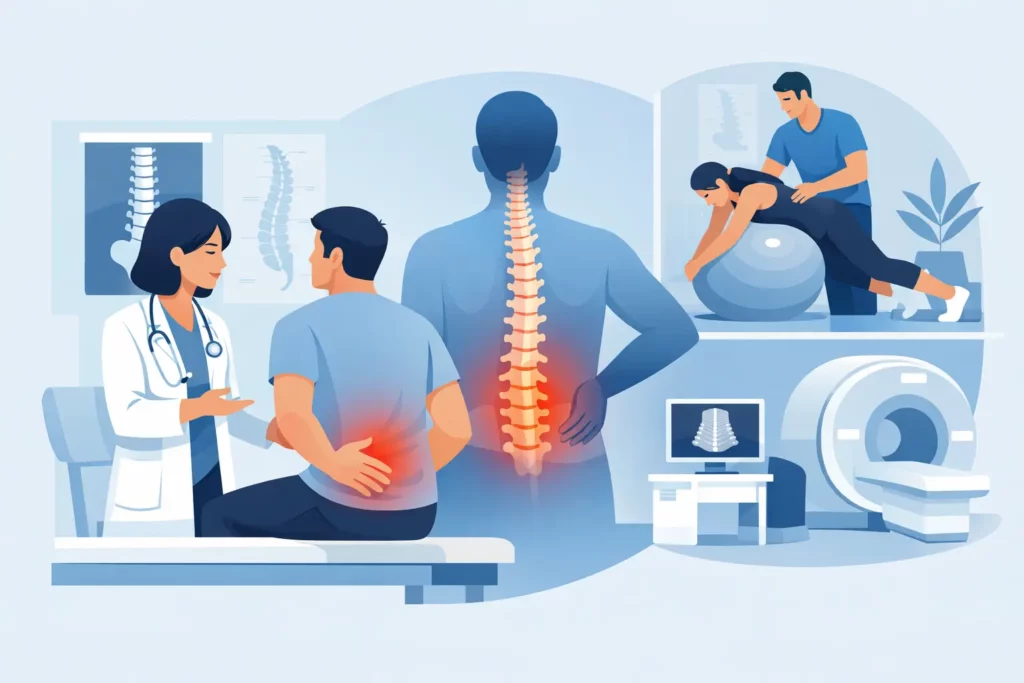
Back pain rarely waits for a convenient moment. It shows up when you are trying to get through a working day, lift a child, train for an event or simply get out of bed without bracing yourself first. For many people, a private back pain clinic becomes the point where guesswork ends and proper treatment begins.
The reason is simple. Back pain is not one condition. It can come from irritated joints, overloaded muscles, disc problems, nerve irritation, poor movement patterns, inflammatory change or a combination of several issues at once. When treatment starts without a clear diagnosis, progress is often slow. When assessment is accurate and the plan is built around the real cause, recovery is usually faster and far more straightforward.
Why people choose a private back pain clinic
Many patients arrive after weeks or months of trying to push through their symptoms. Some have rested for too long and become stiffer. Others have tried general exercises they found online, only to aggravate the pain. Some have had standard treatment elsewhere but still do not know exactly what is driving the problem.
A private back pain clinic offers something different from a one-size-fits-all approach. The main advantage is speed and precision. You are seen quickly, assessed properly and given a treatment plan based on your symptoms, movement and clinical findings rather than broad assumptions.
That matters whether your pain is recent or persistent. Acute back pain may need early intervention to reduce muscle spasm, restore movement and prevent a short-term issue becoming a longer-term limitation. Ongoing back pain often needs a more layered approach, especially if there is weakness, nerve sensitivity, reduced confidence in movement or repeated flare-ups.
For busy adults, private care also tends to be more practical. Appointments are easier to arrange, treatment options are broader and the plan can be adjusted quickly if symptoms change. That responsiveness can make a real difference when pain is affecting sleep, work and everyday mobility.
What a good private back pain clinic should assess
A proper back assessment should not begin and end with where it hurts. Pain location matters, but it does not tell the whole story. A specialist clinician should look at how the symptoms started, what aggravates them, what eases them and whether the pattern points towards mechanical strain, disc involvement, joint restriction, nerve irritation or another musculoskeletal cause.
Physical assessment is equally important. That usually includes spinal movement, strength, flexibility, joint testing, neurological checks where needed and analysis of how you sit, stand, walk and bend. Small details often explain why pain keeps returning. A patient may have a lower back problem, for example, but the underlying issue might also involve hip stiffness, poor core control or compensatory movement after a previous injury.
In a stronger clinical setting, diagnostic ultrasound may also form part of the picture for related soft tissue concerns. While not every type of back pain is suitable for ultrasound imaging, access to imaging-led assessment can be valuable where surrounding structures, referred pain patterns or associated tendon and joint issues need closer review.
This is one of the clearest differences between basic treatment and specialist musculoskeletal care. Good clinicians do not just chase symptoms. They identify what is driving them.
Treatment should match the cause, not the postcode of the pain
Back pain treatment works best when it is specific. Someone with sudden muscular spasm after lifting may respond well to hands-on therapy, pain management advice and a carefully graded return to movement. Someone with persistent lower back pain and recurring flare-ups may need a broader plan that combines manual treatment, targeted rehabilitation and strategies to reduce overload in daily life.
That is why an integrated model matters. In a specialist setting, treatment can include physiotherapy, osteopathy, rehabilitation exercise, acupuncture, dry needling, massage or hydrotherapy, depending on what the clinical picture shows. If inflammation is significant or a joint is particularly irritable, ultrasound-guided injection therapy may also be considered where appropriate.
The key point is that more treatment options do not automatically mean better treatment. The real benefit is having access to the right option at the right time. Some patients need hands-on care first because pain is too limiting for exercise to be effective. Others need movement retraining early because repeated passive treatment alone will not solve the problem. It depends on the diagnosis, symptom severity and recovery stage.
When back pain needs more than standard physiotherapy
Standard physiotherapy helps many people. But not every back problem responds to a straightforward exercise sheet and a few review sessions. If pain has become persistent, if symptoms keep returning, or if previous treatment has not changed much, a more specialist approach is usually sensible.
This is particularly true where there is suspected nerve involvement, referred leg pain, significant stiffness, inflammatory irritation or long-standing dysfunction. In these cases, treatment often needs closer clinical reasoning and tighter coordination between assessment, symptom control and rehabilitation.
A private back pain clinic may also be the better fit for patients who want decisive intervention. That does not mean overtreatment. It means not waiting too long to escalate care when conservative steps are not enough. For some people, reassurance and movement coaching are exactly what they need. For others, reducing inflammation through guided intervention creates the window needed for rehabilitation to finally work.
At FAB Clinic, this joined-up model is central to patient care. Rather than separating diagnosis, pain relief and rehabilitation into different services, the aim is to create one clear route from assessment to recovery.
The value of fast, accurate diagnosis
Back pain can feel alarming, especially when it affects sleep, travel, work or confidence in movement. One of the biggest benefits of private care is clarity. Patients often feel better not only when pain reduces, but when they finally understand what is happening and what the next steps should be.
Fast, accurate insight helps in two ways. First, it reduces wasted time on ineffective treatment. Second, it improves confidence. When you know whether you are dealing with muscular overload, joint irritation, disc-related symptoms or a persistent movement problem, the plan becomes easier to trust and easier to follow.
That trust matters. Recovery is rarely about one appointment. Even with excellent treatment, back pain often improves in stages. Symptoms settle, movement returns, strength builds and resilience improves over time. A good clinic makes that process feel structured rather than uncertain.
Rehabilitation is where lasting change happens
Pain relief is important, but it is only part of the job. If your back feels better for a week and then flares up again as soon as normal life resumes, the root problem has not been fully addressed.
Rehabilitation is what closes that gap. It helps you restore strength, improve control, build tolerance for daily tasks and return to the things that matter to you without fear of setting the pain off again. For one person, that may mean sitting through a commute without stiffness. For another, it may mean returning to tennis, gardening, lifting at the gym or simply walking comfortably for longer distances.
Good rehabilitation is progressive and realistic. It should match your age, fitness, work demands and symptoms rather than expecting everyone to follow the same programme. A working professional with desk-related lower back pain may need a plan built around posture habits, spinal mobility and load management. An older adult may need support with balance, core stability and confidence after repeated episodes of pain. An active patient recovering from injury may need a more performance-focused pathway.
This is where specialist musculoskeletal care has a real advantage. Treatment is not just about reducing pain today. It is about keeping you moving well next month and next year.
Choosing the right clinic for back pain
If you are comparing providers, look beyond appointment availability. The right clinic should offer specialist assessment, evidence-based treatment and a clear explanation of why each stage of care is recommended. You should know what the likely diagnosis is, what the treatment is trying to achieve and how progress will be measured.
It is also worth checking whether the clinic can adapt the plan if needed. Back pain does not always follow a neat timeline. Some people improve quickly. Others need treatment adjusted as symptoms evolve. Access to multiple treatment pathways under one roof can be especially helpful when recovery stalls or symptoms prove more complex than expected.
Convenience matters too, especially in London. If pain is affecting your schedule, work or family responsibilities, responsive booking, extended opening hours and home visit options can make treatment far easier to manage. That practical side of care is often overlooked, but it can be the difference between sticking with a plan and letting symptoms drag on.
Back pain has a way of shrinking daily life when it is left unresolved. The right support should do the opposite. A private back pain clinic should give you answers, effective treatment and a recovery plan built around getting you back to normal movement with confidence.