
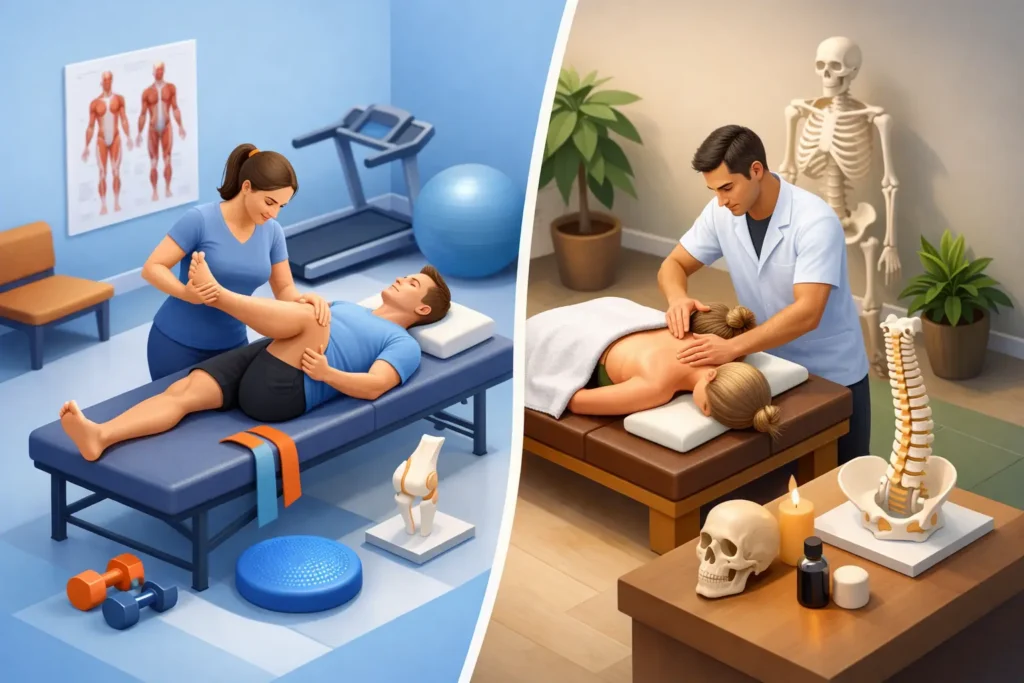
A painful shoulder that will not settle, recurring back pain after long days at a desk, or a knee injury that has stopped you running can leave you asking: physiotherapy or osteopathy? Both professions treat musculoskeletal pain and help people move more comfortably. The right choice is less about a fixed label and more about the nature of your symptoms, your goals and the quality of your assessment.
At FAB Clinic, the priority is to identify what is driving your pain, restore function and build a treatment plan that gives you the best chance of lasting improvement. For some people, that means hands-on treatment and progressive rehabilitation. For others, it means diagnostic ultrasound, shockwave therapy or an ultrasound-guided injection alongside exercise-based care.
Physiotherapy or osteopathy: the key difference
Physiotherapists and osteopaths both assess joints, muscles, tendons, nerves and movement. Both may use hands-on techniques, give advice on activity and prescribe exercises. There is considerable overlap, particularly when a practitioner takes an evidence-based approach and focuses on your individual presentation rather than treating a diagnosis in isolation.
The traditional emphasis is different. Physiotherapy is strongly centred on restoring movement, strength, control and confidence after pain, injury, surgery or illness. A physiotherapist will commonly assess how you walk, squat, lift, reach or perform the specific task that is causing difficulty. Treatment usually combines education, exercise rehabilitation, manual therapy and practical progression back to work, sport or day-to-day activity.
Osteopathy has traditionally placed greater emphasis on hands-on assessment and manual treatment, looking at how different areas of the body may be contributing to symptoms. An osteopath may use soft tissue work, joint mobilisation and manipulation, alongside movement advice and exercise. Modern osteopaths also work with rehabilitation and evidence-informed pain management.
Neither approach should be reduced to a simple rule such as “physiotherapy is exercise” or “osteopathy is massage and manipulation”. Good care is more considered than that. The clinician should explain their findings clearly, discuss the likely causes of your symptoms and adapt treatment as you respond.
When physiotherapy is often the best fit
Physiotherapy is often a strong choice when your main goal is to regain capacity after an injury or manage a problem that changes with load and movement. This includes sports injuries, post-operative rehabilitation, tendon pain, joint instability, muscle strains and return-to-running or return-to-gym programmes.
For example, if you have developed Achilles tendon pain while training for a half marathon, treatment needs more than short-term symptom relief. You may need a structured programme that gradually rebuilds calf strength, improves tolerance to running loads and addresses training errors. If your shoulder hurts when lifting overhead, the focus may be on shoulder strength, movement control and a staged return to the activities that matter to you.
Physiotherapy is also valuable for persistent pain. When pain has lasted for months, it can affect sleep, confidence, work and the willingness to move. A physiotherapist can help you understand safe movement, pace activity sensibly and rebuild strength without repeatedly flaring symptoms. Hands-on treatment may help, but it is normally most useful when it supports an active rehabilitation plan rather than replacing one.
When osteopathy may be a good choice
Osteopathy may appeal if you would like a detailed hands-on assessment and treatment for pain or stiffness, particularly around the spine, neck, hips or shoulders. Many people find manual therapy helpful when they are struggling to move comfortably, feel guarded after an episode of back pain or need support to begin exercising again.
A skilled osteopath will not simply treat the area that hurts. They should consider your movement, medical history, work demands, previous injuries and the way your symptoms behave. For someone with neck pain and headaches, for instance, treatment may include careful hands-on work to improve comfort, alongside advice on posture, breaks, sleep positions and exercises to build neck and upper-back capacity.
Manual techniques can provide a useful reduction in pain and stiffness for some people, especially in the early stages of a flare-up. The trade-off is that the benefit can be temporary if the underlying factors are not addressed. For durable results, it is usually sensible to combine symptom relief with a clear plan for mobility, strength and everyday activity.
Your diagnosis matters more than the treatment label
Choosing between physiotherapy and osteopathy becomes harder when the source of pain is uncertain. Shoulder pain may arise from the rotator cuff, bursa, joint, neck or a combination of factors. Heel pain may be plantar fasciitis, tendon-related, nerve-related or referred from elsewhere. Persistent swelling, catching, marked weakness or pain that does not respond as expected can all change the best course of action.
That is where a thorough musculoskeletal assessment is essential. It should include questions about how the problem started, what aggravates and eases it, previous injuries, medical conditions and your activity goals. It should also involve a physical examination of movement, strength, joints and relevant surrounding areas.
When clinically appropriate, diagnostic ultrasound can provide fast, accurate insight into tendons, muscles, bursae and superficial joints. It is not needed for every ache or injury, and imaging should never replace a clinical assessment. Used well, however, it can clarify the diagnosis and help guide the next step when symptoms are persistent, complex or not improving with standard care.
What treatment should look like in practice
Whether you see a physiotherapist or osteopath, expect a plan that makes sense for your body and your life. A desk-based professional with sudden back pain may initially need help settling symptoms, then a realistic programme to return to commuting, sitting and lifting children. A keen tennis player with elbow pain may need changes to training volume, progressive loading and technique advice, not simply repeated treatment to the sore area.
The plan may include hands-on therapy, joint mobilisation, massage, acupuncture or dry needling where appropriate. These treatments can help create a window in which movement feels easier. They should be paired with targeted rehabilitation that gives you more control over recovery between appointments.
For certain conditions, advanced treatments may be considered. Extracorporeal shockwave therapy can be helpful for selected stubborn tendon problems and plantar fasciitis. Ultrasound-guided joint or soft-tissue injections may be appropriate when inflammation is significantly limiting rehabilitation, or when pain has not responded to a well-delivered conservative programme. These options require careful clinical judgement. An injection may reduce pain, but it is not a substitute for correcting the movement, strength or loading issues that contributed to the problem.
Questions worth asking at your first appointment
The most useful question is not simply, “Are you a physiotherapist or an osteopath?” Ask what the clinician thinks is causing your symptoms, whether there are any warning signs, and what improvement should look like over the next few weeks. You should also understand what you can do at home, which activities are safe to continue and when your plan will be reviewed.
Be cautious of absolute promises or a treatment plan that has no end point. Musculoskeletal recovery is not always linear, particularly with long-standing pain, arthritis or tendon conditions. A credible clinician will explain uncertainty, monitor your response and alter the approach if progress stalls.
In the UK, physiotherapists and osteopaths are regulated professions when they use their protected titles. You can expect a qualified practitioner to work within their scope of practice, recognise when medical review is needed and communicate with other healthcare professionals where necessary.
Making the decision for your recovery
If you want a structured return to sport, work or normal activity after injury, physiotherapy is often the natural starting point. If you value hands-on treatment for pain and stiffness, osteopathy may be a good fit, provided it includes active advice and rehabilitation. In many cases, the distinction matters less than finding a clinician with specialist musculoskeletal expertise, a careful assessment process and access to the right treatment pathway if your recovery needs more support.
Do not let uncertainty delay care while pain limits your life. The right assessment can turn a vague problem into a practical plan, helping you move with greater comfort, confidence and purpose.