
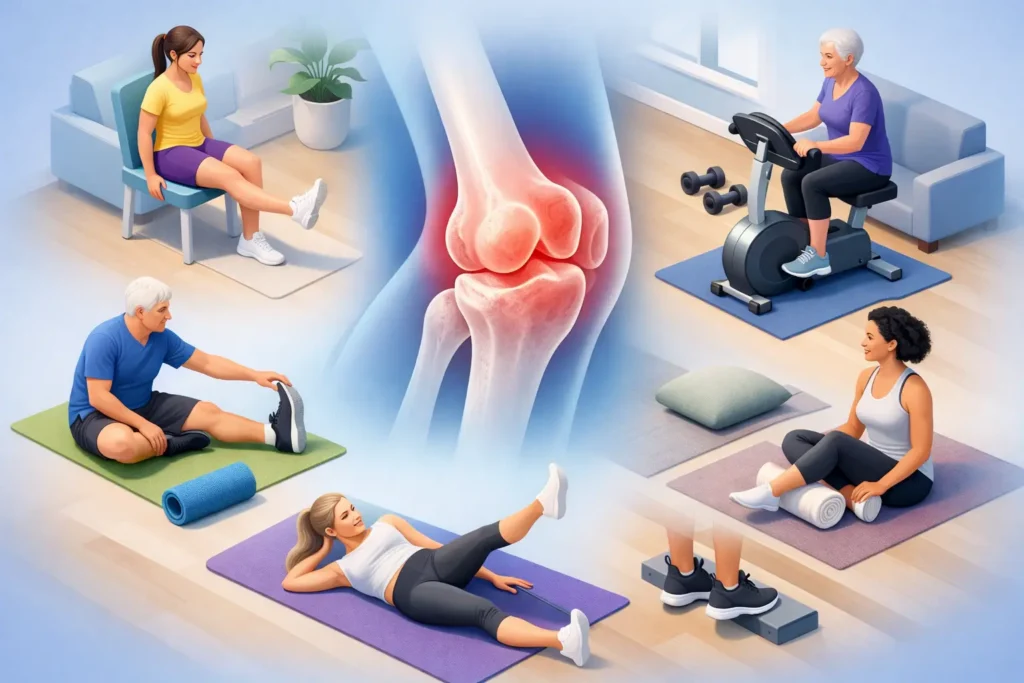
A knee that feels stiff when you first stand up, aches after a walk or becomes unreliable on stairs can make everyday life feel much smaller. The top exercises for arthritic knees are not about pushing through pain or chasing a high-intensity workout. They are controlled movements that strengthen the muscles supporting the joint, maintain comfortable range of motion and help you keep doing the things that matter to you.
Knee arthritis is commonly linked with osteoarthritis, where changes within the joint can lead to pain, stiffness, swelling and reduced confidence in movement. Exercise will not reverse those changes, but the right programme can make a meaningful difference to pain levels, function and mobility. The key is choosing exercises that match your current symptoms and progressing at a sensible pace.
Why exercise helps an arthritic knee
Your knee does not work alone. The quadriceps at the front of the thigh, hamstrings at the back, calf muscles and hip muscles all help control the forces passing through it. When pain causes you to move less, these muscles can weaken quickly. That can leave the knee doing more work with less support.
Regular, well-paced strengthening can improve how the knee copes with walking, standing, getting up from a chair and using stairs. Gentle mobility work can also reduce the feeling of being “stuck” after sitting. For some people, weight-bearing exercise is comfortable and useful; for others, it may be better to start with seated, lying or water-based exercise while symptoms are more irritable.
A little discomfort while exercising is not always a warning sign. Mild muscular effort or a temporary increase in awareness around the knee can be normal. Sharp pain, a limp that worsens, significant swelling, giving way or pain that remains markedly worse into the following day means the exercise needs adjusting.
The 7 top exercises for arthritic knees
Aim for smooth, controlled movement rather than large numbers of repetitions. Start with one set of 8 to 10 repetitions where appropriate, two or three times a week, and build gradually as your knee tolerates it. On stiff days, a shorter session is often more productive than doing nothing at all.
1. Seated knee straightening
Sit upright on a firm chair with both feet on the floor. Slowly straighten one knee until the leg is comfortably extended, tightening the front of the thigh. Hold for two to five seconds, then lower with control. Alternate sides.
This is an accessible way to wake up the quadriceps without placing your full bodyweight through the knee. If straightening the knee fully is painful, work within a smaller range and gradually increase it as symptoms settle.
2. Quad sets
Lie on your back or sit with the affected leg straight and supported. Tighten the thigh muscle by gently pressing the back of the knee down towards the bed or floor. Hold for five seconds, then relax.
Quad sets are particularly useful after a flare-up, when the knee is sore or swollen and heavier exercises feel unrealistic. They maintain contact with the thigh muscles without asking the joint to bend and load deeply.
3. Heel slides
Lie on your back with both legs straight. Slide one heel slowly towards your bottom, allowing the knee to bend as far as is comfortable, then slide it back out. A towel or sock under the heel can make the movement easier on carpet.
Heel slides help maintain knee flexion, which matters for simple daily tasks such as sitting in a low chair, getting into a car or climbing stairs. Avoid forcing the bend. A feeling of stretch is acceptable; pinching or sharp pain is not.
4. Sit-to-stand from a chair
Choose a stable chair, ideally with armrests at first. Place your feet hip-width apart and slightly behind your knees. Lean your chest forward, press through both feet and stand up. Sit down slowly, using the armrests if needed.
This movement closely reflects real life and builds strength in the thighs, hips and trunk. If it is too difficult, use a higher chair or add a firm cushion. If it becomes easy, reduce your reliance on the armrests or slow the lowering phase. Keep your knees pointing in the same direction as your toes rather than letting them collapse inwards.
5. Supported mini-squats
Stand facing a kitchen worktop or the back of a sturdy chair, holding on lightly. Bend at the hips and knees as though beginning to sit down, then return to standing. Keep the movement shallow – often no more than 30 to 45 degrees of knee bend is enough.
Mini-squats develop leg strength in a functional standing position. Depth is not the goal. A smaller, well-controlled squat that feels comfortable is more valuable than a deep squat that aggravates symptoms. People with pain at the front of the knee may find this exercise more comfortable with a reduced range.
6. Standing calf raises
Hold a worktop for balance and stand with your feet hip-width apart. Rise up onto the balls of your feet, pause briefly, then lower your heels slowly. Keep your weight evenly spread through both legs.
Strong calves support walking and improve control during the push-off phase of each step. This is often a good option for people whose knee is sensitive to bending, as it trains the lower limb with minimal knee movement. Start with both legs; progress to more repetitions before considering single-leg work.
7. Side-lying hip abduction
Lie on your side with the lower knee bent for balance and the top leg straight. Keeping the top foot facing forwards, lift the leg slowly towards the ceiling without rolling your pelvis backwards. Lower it with control.
The muscles at the side of the hip help keep the pelvis and knee aligned when you walk, climb stairs or step down from a kerb. Better hip control can reduce unwanted strain through the knee, particularly if your knee tends to drift inwards during movement.
Add low-impact activity between strength sessions
Strength work is only one part of a useful arthritis plan. Short, regular bouts of walking, a stationary bike, swimming or hydrotherapy can help reduce stiffness and improve cardiovascular fitness without the repeated impact of running or jumping. The best option is the one you can repeat consistently.
Cycling is often comfortable because the knee moves through a controlled range without taking full bodyweight. However, a low saddle can force excessive knee bend and irritate symptoms. Set the saddle so there is a slight bend in the knee at the bottom of the pedal stroke, and begin with low resistance.
Walking can be equally valuable, but dose matters. Rather than one long walk that causes a two-day flare-up, try shorter walks spread across the day. Supportive footwear and a route with fewer steep slopes may make a noticeable difference.
How to judge the right exercise level
Use your symptoms as feedback, not as a reason to avoid all movement. During exercise, aim to keep pain mild and manageable. Afterwards, your knee should settle back towards its usual level within 24 hours. If it does not, reduce one variable next time: the number of repetitions, range of movement, resistance or frequency.
A flare-up does not necessarily mean you have caused damage. Arthritis symptoms can fluctuate with activity, sleep, stress, illness and changes in routine. Pause high-load activity if needed, keep some gentle movement going and restart at a level your knee accepts. Consistency over weeks matters far more than an occasional hard session.
When specialist assessment is the better next step
Exercise should be individualised if your knee is hot and significantly swollen, repeatedly locks or gives way, has changed shape, or pain is stopping you from sleeping and walking normally. You should also seek assessment after a fall or twisting injury, particularly if you cannot comfortably bear weight.
If you have tried general exercise but are still struggling, an accurate musculoskeletal assessment can identify whether the knee joint is the main issue or whether the hip, back, foot mechanics, tendon pain or an old injury is contributing. At FAB Clinic, physiotherapy can be combined with diagnostic ultrasound and, where clinically appropriate, further pain-management options to create a precise treatment and rehabilitation plan.
Your starting point does not need to be dramatic. One controlled sit-to-stand, a short walk or a few heel slides is still a positive signal to an arthritic knee: it is supported, it can move, and it has a practical route back towards greater confidence.