
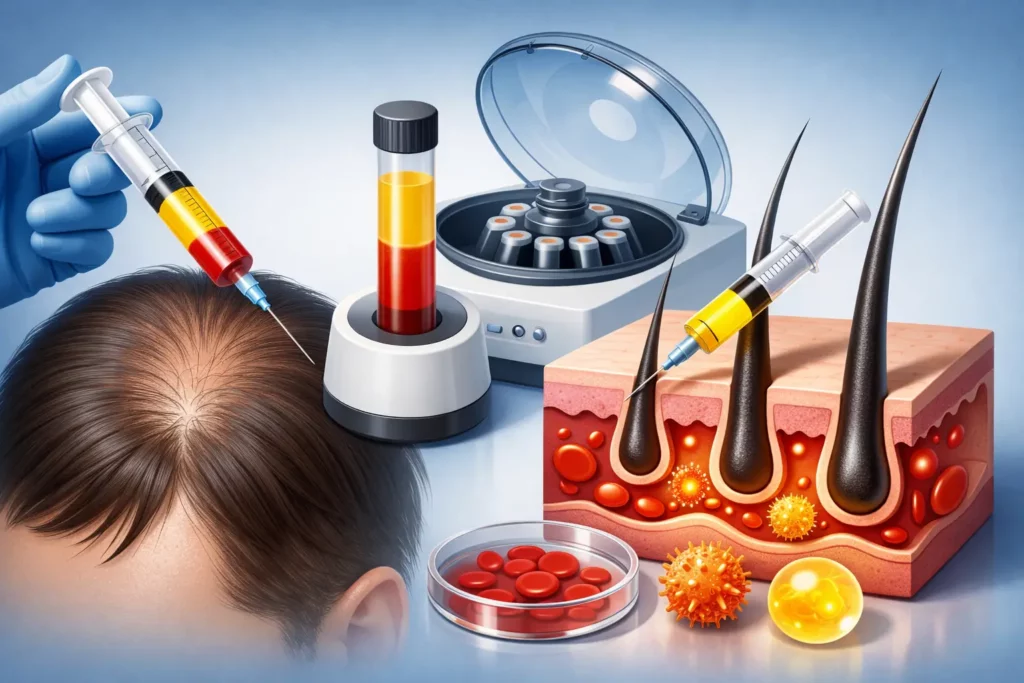
Hair thinning rarely arrives all at once. More often, it shows up in the mirror under bright bathroom light, in a widening parting, or in the extra strands left in the shower. For many patients, platelet rich plasma (PRP) for hair growth becomes part of the conversation when they want a treatment that is minimally invasive, clinically grounded, and aimed at improving hair quality before loss becomes more advanced.
PRP has gained attention because it uses your own blood components rather than a synthetic drug or surgical approach. That makes it appealing, but it does not mean it is simple, guaranteed, or right for every type of hair loss. As with any regenerative treatment, results depend on diagnosis, timing, technique, and the wider treatment plan.
What is platelet rich plasma (PRP) for hair growth?
Platelet rich plasma is a concentrated portion of your own blood that contains a higher level of platelets than normal circulating blood. Platelets are best known for their role in clotting, but they also contain growth factors and signalling proteins involved in tissue repair.
In hair treatment, a clinician takes a blood sample, processes it to separate and concentrate the platelet-rich component, and then injects that plasma into areas of the scalp affected by thinning. The aim is to stimulate the environment around the hair follicle and support healthier growth cycles.
This is not a hair transplant, and it does not create new follicles where follicles are completely absent. It is better understood as a treatment designed to support weakened or miniaturising follicles that are still active but underperforming.
How PRP may help thinning hair
Hair follicles cycle through phases of growth, transition, rest, and shedding. In common pattern hair loss, follicles gradually shrink over time. The hair becomes finer, shorter, and less dense until the follicle may stop producing meaningful hair growth.
PRP is thought to help by delivering growth factors into the scalp that may improve blood supply, reduce local inflammation, and encourage follicle activity. In some patients, that can translate into thicker individual hairs, reduced shedding, and improved density. The most realistic goal is often improvement rather than transformation.
This distinction matters. Patients tend to do best when they understand that PRP is usually about slowing decline and enhancing existing growth, especially in early or moderate stages of thinning.
Who is most likely to benefit from PRP for hair growth?
PRP tends to be most suitable for men and women with early-stage androgenetic alopecia, often called pattern hair loss. These are the patients who still have visible hair in the affected area, even if it has become finer and more sparse.
It may also have a role in some cases of hair shedding linked to stress or illness, but only after the underlying trigger has been assessed. If hair loss is caused by iron deficiency, thyroid dysfunction, inflammatory scalp disease, medication, or hormonal change, PRP alone is unlikely to be the best first step.
The quality of assessment is crucial. A treatment can only be as precise as the diagnosis behind it. That is why a medical review of your hair loss pattern, scalp health, timeline, family history, and wider health is more than a formality. It shapes whether PRP is appropriate or whether another route is likely to give better results.
When PRP is less likely to work
There are clear limitations. If an area of scalp has been bald and smooth for a long time, PRP is far less likely to help because there may be too little viable follicle activity left to stimulate. It is also not an ideal stand-alone solution for scarring alopecia or untreated inflammatory scalp conditions.
Results may be weaker in patients with advanced hair loss, active smoking, poor general health, or untreated nutritional and hormonal issues. Some people are also simply disappointed because they expect the sort of density change associated with surgery. PRP does not replace a transplant when extensive restoration is needed.
That does not make it ineffective. It means it has a narrower and more realistic place within treatment planning than marketing claims sometimes suggest.
What happens during treatment?
Most PRP sessions are relatively straightforward. A blood sample is taken, then placed in a centrifuge to isolate the platelet-rich component. Once prepared, the PRP is injected across the targeted areas of the scalp using a series of small injections.
The appointment is usually brief, although exact timings vary by clinic and protocol. The scalp can feel tender afterwards, and some patients notice mild redness, tightness, or a temporary headache. These effects are usually short-lived.
Because PRP is derived from your own blood, the risk of allergic reaction is low. Even so, low risk does not mean no risk. Infection, bruising, discomfort, and variable response are all part of the consent discussion that should happen before treatment.
How many sessions are usually needed?
This is one of the most important practical questions, because PRP is rarely a one-off intervention. Most treatment plans involve an initial course of sessions followed by maintenance treatment if the patient responds well.
Protocols differ between clinics, but many recommend a cluster of early sessions over several months and then review progress. Hair growth is slow by nature, so meaningful change is not usually judged after a couple of weeks. Patients often need patience as well as consistency.
If there is going to be benefit, it tends to emerge gradually. Shedding may reduce first, followed by subtle thickening and improved appearance over time. The point at which progress becomes visible depends on the individual, the severity of thinning, and whether PRP is being used alongside other treatments.
PRP compared with other hair loss treatments
PRP sits in the middle ground between topical or oral treatment and surgery. It is more intervention-based than home treatment, but less invasive than transplantation.
Compared with medicines such as minoxidil or finasteride, PRP may appeal to patients who want to avoid daily medication or are concerned about side effects. On the other hand, medicines have a longer evidence base in pattern hair loss and are often more affordable over time. In many cases, combination treatment produces the strongest overall result.
Compared with a hair transplant, PRP is less invasive and has minimal downtime, but it cannot move follicles into bare areas or rebuild a significantly receded hairline in the same way. It is often better seen as a support treatment, either before hair loss becomes advanced or alongside other therapies.
What does the evidence say?
The research on PRP for hair growth is encouraging but not flawless. A number of studies suggest benefit in hair density, hair thickness, and patient satisfaction, particularly in androgenetic alopecia. However, the evidence is still affected by variation in preparation methods, injection technique, treatment intervals, and study quality.
That variability matters in real clinical practice. PRP is not one single standardised product. The concentration of platelets, whether white blood cells are included, how the sample is spun, and how it is injected can all influence outcomes. This is one reason why one patient may describe excellent results while another sees very little change.
The most reliable way to think about the evidence is this: PRP has genuine clinical potential, especially in appropriately selected patients, but it is not a guaranteed fix and should not be sold as one.
Is platelet rich plasma (PRP) for hair growth safe?
For most suitable patients, PRP is considered low risk because it uses autologous material, meaning the treatment comes from your own body. That reduces the chance of incompatibility. Still, safe treatment depends on sterile technique, correct preparation, and proper screening.
Patients with certain blood disorders, active infection, some scalp conditions, or those taking particular medications may not be suitable. Good clinics do not rush through that assessment. They take a careful history, explain expected outcomes honestly, and discuss whether the likely benefit justifies the cost and commitment.
That measured approach is what evidence-based private care should look like. At FAB Clinic, that same principle runs through every treatment plan: accurate assessment first, then a clear route towards the most appropriate intervention.
The question to ask before booking
The best question is not simply, “Does PRP work?” It is, “Is my type of hair loss likely to respond to PRP, and what is the best treatment plan for me?”
That shift in focus usually leads to better decisions. Hair loss is not one condition, and there is no single treatment that suits every scalp, every age group, or every stage of thinning. A good clinician should be able to explain not only what PRP might do, but also what it probably will not do in your specific case.
If you are considering treatment, early assessment is often worthwhile. The sooner thinning is properly evaluated, the more options tend to be available. Waiting until hair loss is advanced can narrow those options considerably.
For patients who are suitable, PRP can be a useful part of a broader strategy to protect hair density and improve confidence. The key is to treat it as a clinical decision, not a cosmetic gamble.