
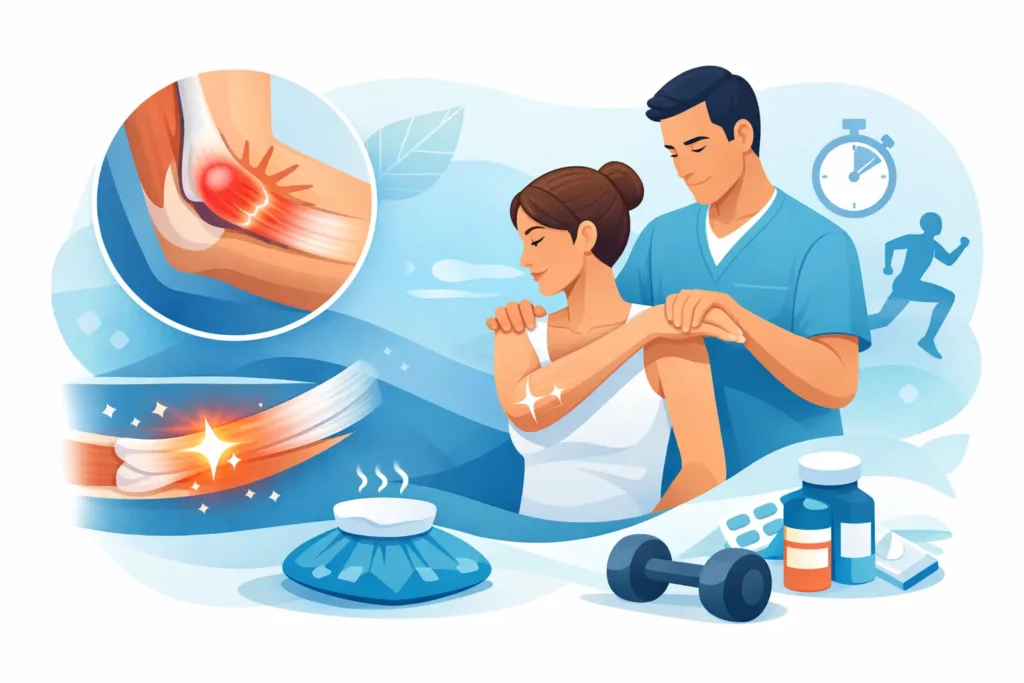
A sore tendon can seem minor at first – a niggle in the shoulder, elbow, knee or heel that you expect to settle on its own. Then weeks pass, it still hurts to lift, grip, climb stairs or walk, and you start asking what helps tendonitis heal faster. The honest answer is not complete rest or trying to push through it. Tendons usually recover best with the right diagnosis, the right amount of load, and a treatment plan that matches how irritated the tissue really is.
What helps tendonitis heal faster in real life?
The fastest route to recovery is usually a combination of reducing the aggravating strain, keeping the tendon moving within tolerance, and building it back up gradually. That balance matters. Too much rest can leave the tendon weaker and more sensitive, while too much activity can keep it irritated and delay healing.
This is why tendon pain often becomes stubborn. Many people either stop everything for too long or carry on with the same habits that caused the problem. Neither approach gives the tendon what it needs. A more effective plan is precise. It looks at where the pain is, what stage the problem is in, how long it has been going on, and which movements are overloading the area.
Tendonitis is also used as a catch-all term, but not every painful tendon is acutely inflamed. In many longer-lasting cases, the issue is more about failed healing and tendon overload than classic inflammation. That distinction affects treatment. If the diagnosis is vague, recovery is usually slower.
Start with accurate diagnosis, not guesswork
If your pain has lasted more than a couple of weeks, keeps returning, or is stopping you from working, training or sleeping comfortably, proper assessment makes a real difference. Tendon pain can mimic bursitis, joint irritation, nerve referral or partial tears. The right treatment depends on knowing which structure is involved and how severe the problem is.
Clinical examination is the first step, but imaging can be especially useful when symptoms are persistent or unclear. Diagnostic ultrasound offers fast, accurate insight into tendon thickening, tearing, inflammation around the tendon and related soft tissue changes. It can also help guide treatment decisions rather than relying on trial and error.
For patients who want decisive intervention and a clearer plan, this is often where specialist musculoskeletal care stands apart from basic advice to simply rest and wait.
Load management is more effective than total rest
One of the biggest myths is that tendons heal fastest when you avoid using them. In the very early stage, short-term relative rest can calm things down. If a tendon is highly reactive, reducing the activities that spike pain is sensible. But prolonged rest usually does not restore strength or function.
Tendons respond to load. They need measured, progressive loading to recover well. That might mean temporarily cutting back running volume for Achilles tendon pain, reducing heavy gripping for tennis elbow, or modifying overhead lifting for shoulder tendon problems. The goal is not to stop everything forever. It is to reduce the load enough to settle symptoms while keeping the tendon active enough to promote recovery.
A simple rule is that exercise should be tolerable during the activity and should not cause a significant flare-up that lingers into the next day. Some discomfort can be acceptable. Sharp pain, worsening stiffness and clear loss of function are signs the load is too high.
Exercise is usually the main treatment
When people ask what helps tendonitis heal faster, the answer most often comes back to targeted rehabilitation. This is not generic stretching from the internet. The tendon needs the right type of exercise, at the right stage, with the right progression.
In the more painful early phase, isometric exercises can sometimes reduce pain and allow the tendon to tolerate movement better. As symptoms settle, heavier slow resistance work is often introduced to improve tendon capacity. Later still, energy-storage and functional drills may be needed for people returning to running, racquet sports, gym training or physical work.
This is where physiotherapy can speed things up. A structured programme gives you a progression, rather than leaving you to guess whether you should stretch, strengthen or stop. It also adapts if recovery stalls. A desk-based professional with elbow tendon pain, a runner with patellar tendon pain and an older adult with gluteal tendon pain will not all need the same plan.
Pain relief helps, but it is not the whole solution
Reducing pain can help you move more normally and stick with rehabilitation. Ice may ease symptoms in the short term, especially if the area feels hot or irritated after activity. Some patients find short-term pain relief with anti-inflammatory medication, but this depends on the stage of the condition, your general health and whether inflammation is truly a major driver.
Pain relief has a place, but it should support recovery rather than replace it. If you rely only on medication or passive treatments while the tendon remains weak and overloaded, symptoms often return as soon as you become more active again.
That is also why repeated deep massage of an acutely aggravated tendon is not always the best answer. Hands-on treatment can help surrounding muscle tension and movement patterns, but the tendon itself usually needs a broader rehabilitation strategy.
Why some cases need more than standard physiotherapy
Most tendon problems improve with the right exercise plan, but some become persistent. If symptoms have been present for months, if there is significant thickening or degeneration, or if standard treatment has failed, more targeted options may help accelerate progress.
Extracorporeal shockwave therapy can be useful in selected chronic tendon conditions, including Achilles tendinopathy, plantar fasciitis, patellar tendinopathy and some gluteal tendon problems. It works by stimulating a healing response in tissue that has stopped progressing well on its own. It is not appropriate for every patient, but in the right case it can be a valuable addition to rehabilitation rather than a stand-alone fix.
Ultrasound-guided interventions may also be considered when pain is severe or when adjacent structures are contributing to symptoms. The benefit of image-guided treatment is precision. Rather than treating the area broadly, it allows care to be directed exactly where it is needed.
At a specialist clinic such as FAB Clinic, this integrated model – combining assessment, imaging, hands-on care and advanced treatment options under one roof – can help patients move forward more quickly when standard routes have not worked.
Sleep, general health and recovery still matter
Tendons do not heal in isolation from the rest of the body. Poor sleep, high stress, smoking, poorly managed diabetes, low activity levels and inadequate recovery time can all slow healing. So can trying to train hard through pain because life is busy and rest feels inconvenient.
That does not mean you need perfect habits to get better. It does mean recovery is often faster when the basics are working in your favour. Good sleep, steady protein intake, sensible training modification and keeping the rest of the body active all support the healing process.
Weight can also be relevant in some tendon conditions, particularly around the lower limb. More load through the tendon can mean slower progress if capacity is already reduced. The answer is not blame. It is to adjust the plan so healing becomes more achievable.
What usually slows tendon healing down?
The most common reason is doing too much, too soon, too often. That might be repeated lifting at work, returning to running before the tendon is ready, or restarting sport at full intensity because the pain has eased for a few days. Tendon pain can be deceptive. It may feel manageable during activity and then flare later.
Another common issue is underloading the tendon for too long. If you are six weeks in and still only avoiding movement, the tissue is unlikely to regain normal function. Recovery slows when the tendon never gets a chance to rebuild tolerance.
Poor diagnosis is another major factor. If the pain is actually coming from a tear, a bursa, the joint or referred pain from elsewhere, standard tendon advice may not help much at all. That is when people start to feel they have tried everything, when in reality they have been treating the wrong problem.
When to seek expert help
If the pain is severe, if you felt a sudden snap, if there is marked weakness, or if you cannot use the limb normally, get assessed promptly. The same applies if symptoms have not improved after a few weeks of modifying activity and starting sensible rehabilitation.
You should also seek specialist input if the problem keeps coming back. Recurrent tendon pain often means the underlying capacity has not been rebuilt, or the diagnosis has not been specific enough. A stronger plan can make the difference between temporary relief and lasting improvement.
For many patients, the real turning point is not finding a magic shortcut. It is getting a clear diagnosis, reducing the right aggravating factors, and following a treatment plan that steadily restores tendon strength and function. That is what helps most people heal faster – and stay better once they are back to normal life.